Machine learning has different approaches for enabling computers to learn from data and experiences. These approaches can be broadly categorised into three types: supervised learning, unsupervised learning, and reinforcement based learning. Among them, reinforcement based learning plays a crucial role in areas that require decision-making and continuous improvement. Unlike supervised and unsupervised learning, reinforcement based learning does not rely on labelled datasets or clustering patterns. Instead, it focuses on learning through interaction, trial and error, rewards, and punishments, making it especially powerful in dynamic and uncertain environments.
What is Reinforcement Based Learning?
Reinforcement based learning is a method where an agent learns how to act in an environment in order to maximise total rewards. The agent does not receive direct instructions on which actions to take. Instead, it explores the environment, performs actions, and receives feedback in the form of rewards or penalties. Over repeated interactions, the agent refines its decisions to achieve the best possible outcome.
In simple terms, reinforcement based learning works much like how humans or animals learn new behaviours. For example, a child learns not to touch a hot object after experiencing discomfort once. Similarly, an AI agent adjusts its behaviour based on past results.
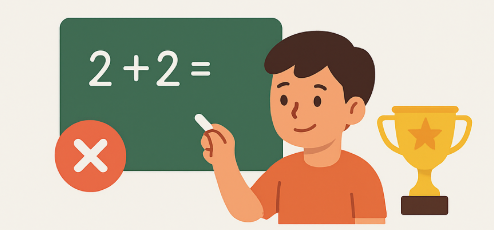
Another example to understand reinforcement based learning is when a student is asked to solve a mathematical problem. The student is not told how to solve it beforehand but is given a reward for solving it correctly and a punishment if the solution is wrong. Over time, the student learns which approaches lead to success, much like how an AI agent improves its decisions through repeated feedback.
Environment-Agent Interaction
At the heart of reinforcement based learning lies the continuous interaction between the agent and the environment. This process is usually represented in the following loop:
- Agent: The learner or decision-maker that chooses actions.
- Environment: Everything the agent interacts with, such as a virtual game world or a physical robot’s surroundings.
- State: A snapshot of the environment at a given moment.
- Action: A move or decision taken by the agent.
- Reward: The feedback signal provided by the environment, which can be positive (reward) or negative (punishment).
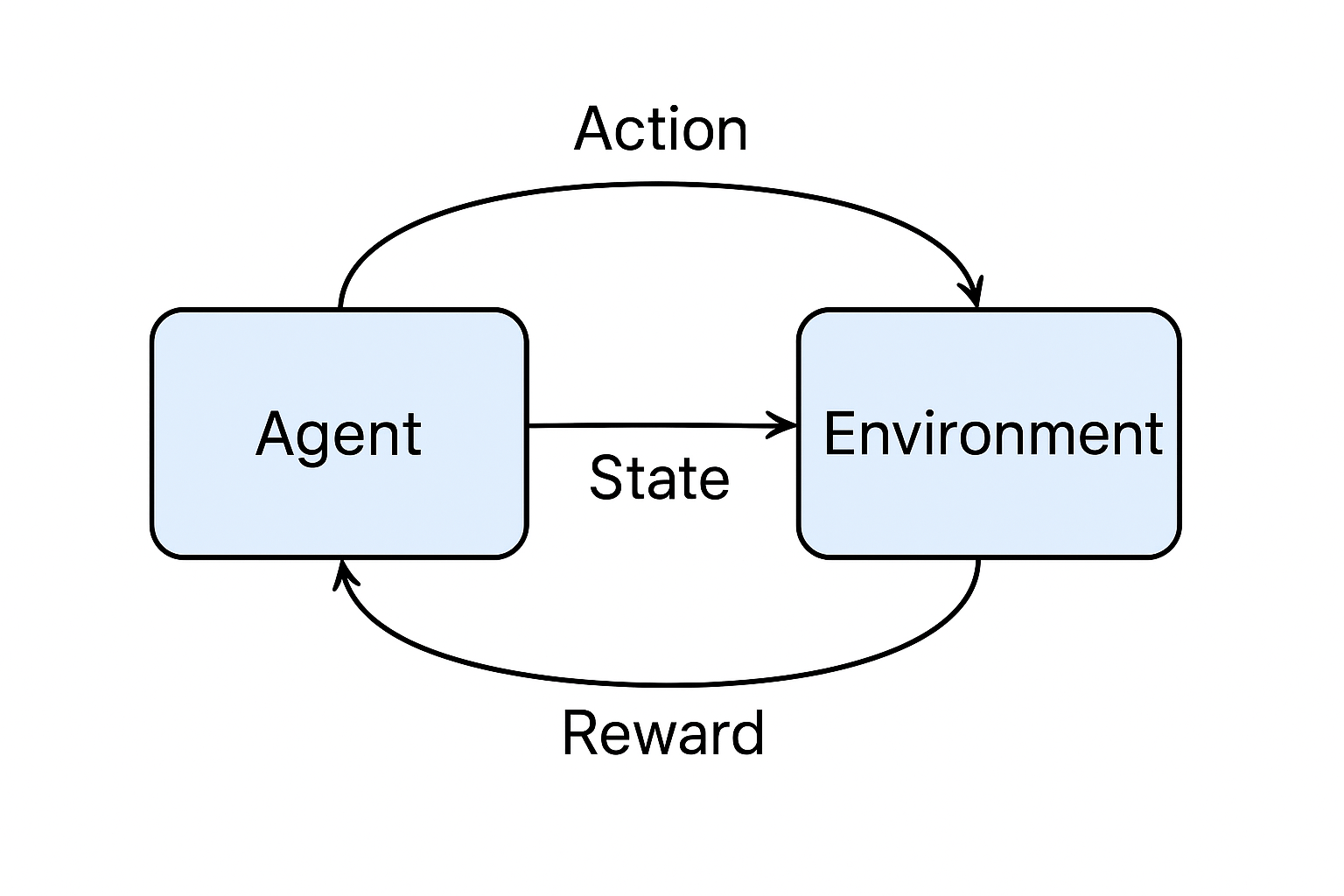
The cycle repeats, allowing the agent to learn from past experiences and optimise future behaviour.
Rewards, Punishments, and Learning Loops
The entire learning process in reinforcement based learning revolves around rewards and punishments.
- Reward: When the agent performs a good action that leads towards the desired goal, it receives a positive reward. This encourages similar actions in the future.
- Punishment: When the agent makes a poor choice, it receives a negative reward (or penalty). This discourages repeating the same mistake.
Through repeated learning loops, the agent builds a policy: a strategy that maps states to the best possible actions. Over time, this policy becomes more efficient, guiding the agent towards better performance.
This trial-and-error process closely resembles how humans learn skills, such as riding a bicycle, playing chess, or improving at a video game.
In the example from earlier where a student does a mathematical problem, the student is like the agent, the mathematical problem is the environment, the solution attempt is the action, and the feedback (reward for correct, punishment for incorrect) represents the reward mechanism.
Real-World Examples of Reinforcement Based Learning
Reinforcement based learning has gained immense popularity because of its adaptability and effectiveness in complex tasks. Some of the most prominent real-world applications include:
1. Game Artificial Intelligence
One of the most famous examples is AlphaGo, developed by Google DeepMind. It mastered the ancient game of Go by playing millions of matches against itself. Through reinforcement based learning, it discovered strategies beyond human imagination, even defeating world champions. Similarly, reinforcement based learning powers AI in modern video games, enabling computer-controlled characters to make intelligent moves.
Did you Know?
| AlphaGo, the AI developed by DeepMind, made a move in its 2016 match against world champion Lee Sedol (known as Move 37) that was so unexpected and creative that experts first thought it was a mistake. Later, they realised it was a brilliant strategy that turned the game in AlphaGo’s favour. |
2. Robotics
Robots often operate in uncertain and changing environments. Reinforcement based learning helps robots learn how to walk, balance, and manipulate objects without needing detailed programming for every situation. For example, four-legged robots trained with reinforcement learning can change the way they walk when moving on rough ground.
3. Autonomous Vehicles
Self-driving cars use reinforcement based learning to make driving decisions such as accelerating, braking, or turning. By receiving feedback on safety and efficiency, these systems gradually improve their ability to navigate complex traffic conditions.
4. Resource Management and Optimisation
Beyond robotics and games, reinforcement based learning is used in energy management, finance, and healthcare, where systems must constantly balance competing goals while optimising performance over time.
AI in News
| Doctors are starting to use reinforcement learning in telemedicine to manage patients more effectively. The system learns from feedback to adjust doctor availability, balance resources, reduce waiting time, and lower costs while giving patients quicker and better care. Read more |
Why is Reinforcement Based Learning Important?
Reinforcement based learning is important because it gives machines the ability to make decisions step by step in changing situations. Many real-world problems are not fixed but keep changing, and this makes reinforcement based learning very useful.
Unlike supervised learning, it does not need a large set of labelled examples to learn from. This means it can work well even when there is no clear guide for every possible situation. At the same time, unlike unsupervised learning, it does more than simply finding patterns. It learns strategies and behaviours that lead to successful outcomes.
The importance of reinforcement based learning can be seen in several ways:
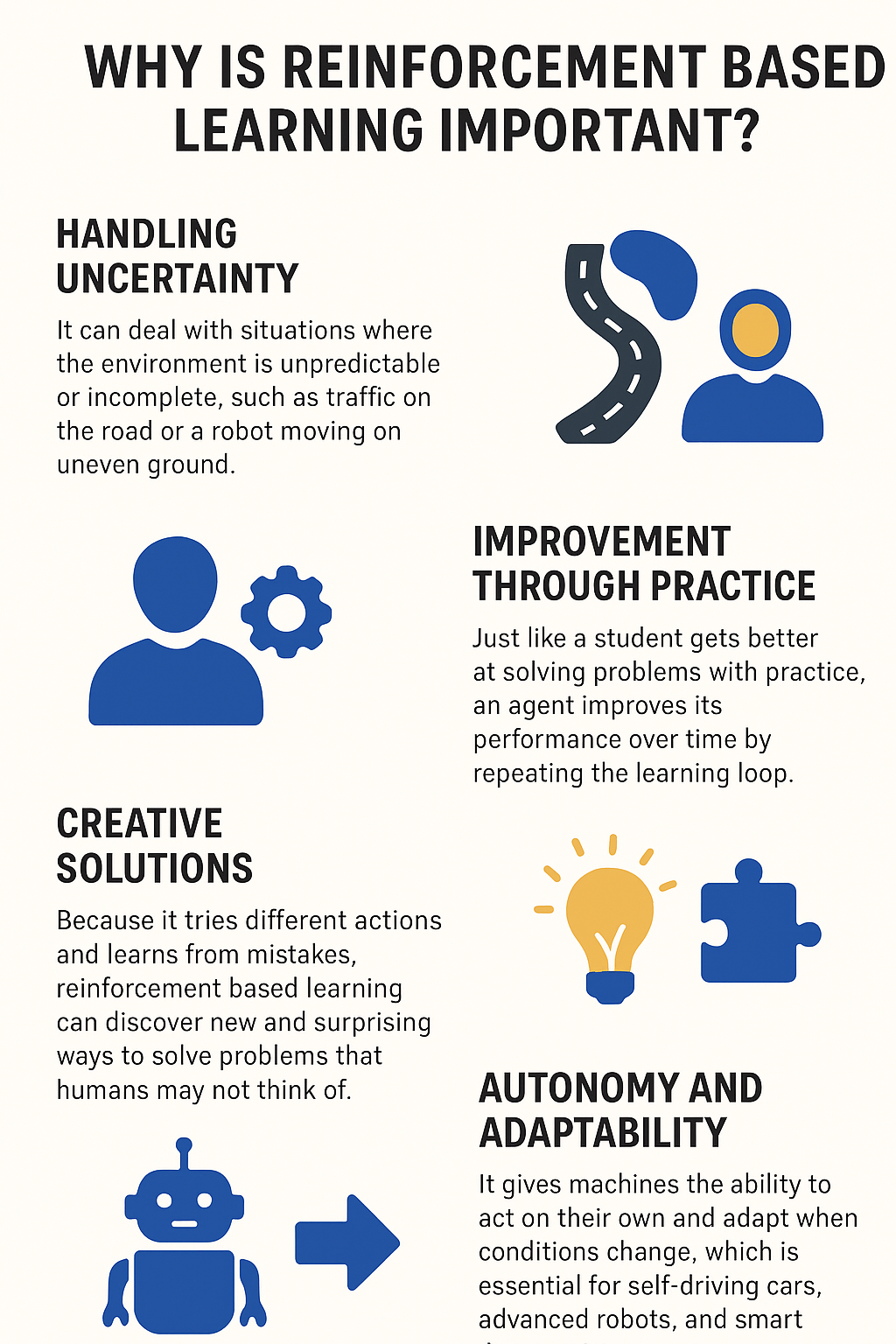
In simple terms, reinforcement based learning is important because it allows machines to learn from experience, improve continuously, and make smart choices in real-world situations. For example, a robot vacuum cleaner may at first bump into walls and furniture while trying to clean the floor. Over time, it receives feedback when it successfully cleans an area or avoids obstacles. Using reinforcement based learning, it gradually improves, finding efficient paths and cleaning more effectively without being directly programmed for every possible room layout.
Reinforcement based learning represents the third pillar of machine learning methods, standing alongside supervised and unsupervised learning. It is a powerful approach that equips machines to learn from experience, adapt to new situations, and make intelligent decisions in complex environments. By combining environment-agent interaction, reward-based feedback, and continuous learning loops, reinforcement based learning opens doors to innovations in gaming, robotics, self-driving cars, and many other fields.
As technology advances, reinforcement based learning will play an increasingly vital role in shaping intelligent systems that can learn, evolve, and perform in ways that resemble human problem-solving.