Deep learning is a specialized field of artificial intelligence within machine learning that focuses on teaching computers to learn from data. It is inspired by the way the human brain works, using a structure called a neural network. These networks are made up of layers of artificial “neurons” that process information step by step.
Instead of explicitly programming every instruction, deep learning allows computers to discover patterns and rules automatically.
Example: Imagine you want a computer to recognise different musical instruments. Instead of writing thousands of rules like “if it has strings, it is a guitar,” you simply give the computer lots of audio clips labelled “guitar,” “piano,” “violin,” etc. The system will find its own rules to classify the sounds.
Deep Learning Vs Machine Learning
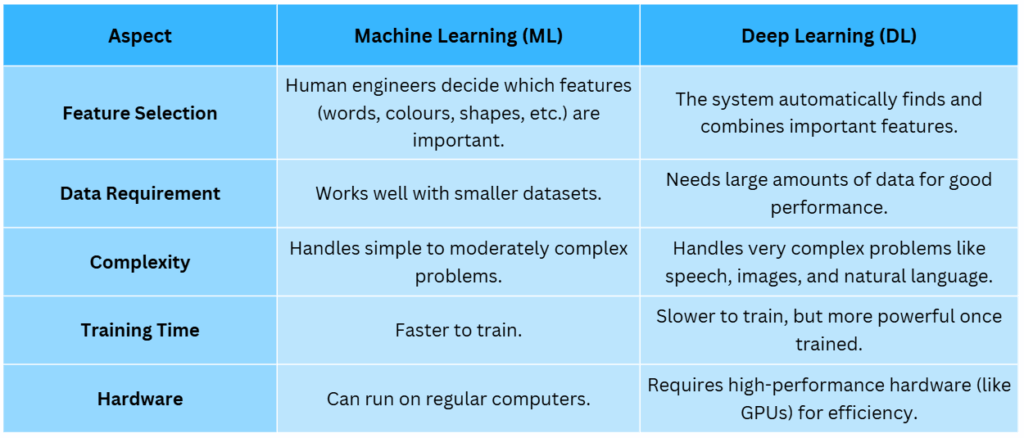
People often confuse machine learning (ML) and deep learning (DL). While deep learning is a part of machine learning, the two are not the same. Machine learning models usually need human guidance to select features and patterns, while deep learning models automatically learn these features through many layers of processing.

For example, a thermostat with machine learning might only raise the temperature if you say the exact phrase “it is cold.” With deep learning, the thermostat understands the idea of being cold even if you use different words like:
“I’m freezing.”
“The room feels chilly.”
“The heater should be on.”
In all these cases, the deep learning model recognises the underlying concept, that you want the room warmer and adjusts the temperature automatically.
How is Deep Learning Different from Regular Programming?
In traditional programming, humans write the rules. These rules process the input and generate the output.

For example, To detect spam emails, you might manually create rules like “if the subject contains the word ‘lottery,’ mark it as spam.” This is called traditional programming.
In deep learning, the computer uses the input and the desired output to discover the rules on its own.

For example, you feed the computer thousands of emails marked “spam” or “not spam,” and it figures out the patterns on its own, such as unusual sender addresses or text styles. This is known as deep learning.
Thus deep learning is ideal for problems where the rules are too complex for humans to define.
How Do Computers “Learn” from Examples?
Computers learn using a process called training. During training, a model sees lots of data and slowly improves by correcting mistakes.
Steps in learning:
- Input data: Feed the model examples (images, sounds, text).
- Prediction: The model makes a guess.
- Error check: The guess is compared to the correct answer.
- Adjustment: The model updates itself to reduce errors.
Over time, the system becomes highly accurate.

For example:
A construction company can train a deep learning model to detect cracks in concrete bridges. First, engineers provide input data by uploading thousands of labelled photos — some with cracks, some without. The model then makes a prediction, scanning a new photo and guessing whether a crack is present. This guess is checked against the correct answer in the error check step. If the model is wrong, it makes an adjustment to improve its internal rules. This cycle is repeated many times, and over time the system becomes highly accurate. Eventually, the trained model can scan new bridge photos and automatically highlight cracks, saving engineers time and helping to prevent accidents.
Did you Know?
| Training a large deep learning model can sometimes take weeks and require hundreds of powerful computers working together? |
Why is it called “Deep”?
The “deep” in deep learning refers to the many layers of the neural network. Each layer processes data at a higher level of abstraction.
- The first layer may recognise basic features (lines, edges, curves).
- The next layers combine those features into parts (a window, a wheel, a leaf).
- The final layer identifies the whole object (a car, a house, or a tree).
The more layers a model has, the more “deep” it becomes, enabling it to understand complex patterns like human speech, weather trends, or even abstract art.
Importance of Deep Learning
Deep learning has become the backbone of modern artificial intelligence. It has moved beyond simple automation to solving real-world problems in ways that were impossible with traditional programming.
Unique and Practical Applications:
- Healthcare: Detecting diseases from scans, predicting patient recovery patterns, and even designing new medicines. For example, Google’s deep learning model helps detect diabetic retinopathy in eye scans. (Google AI Retinopathy Project)
- Agriculture: Farmers use drones with deep learning to scan crops for pests or water shortages. This helps improve food security and reduce waste.
- Environmental protection: IBM researchers use deep learning to predict natural disasters such as floods or hurricanes by analysing satellite data. (IBM AI for Weather)
- Education: Language learning apps use deep learning to give instant feedback on pronunciation and grammar, personalising lessons for each student.
- Language preservation: Deep learning helps document endangered languages by turning spoken words into written scripts automatically.
Deep learning is not just another programming method. It is a revolution in how machines understand the world. By learning from examples instead of fixed rules, deep learning enables breakthroughs in healthcare, agriculture, environment, and culture. Its depth and flexibility make it one of the most important technologies driving artificial intelligence today.