When you ask an AI model a question, the way you phrase it can completely change the answer. For example, asking “Tell me about dogs” might give a general overview, while “Give me five tips for training a Labrador puppy” gives a clear, actionable response. Even small changes in wording can make a big difference. This is why structuring your prompt carefully is so important.
AI models follow instructions literally, they don’t “guess” your intentions. Providing clear context, examples, or constraints helps guide them toward the kind of answer you want. Well-structured prompts save time, reduce confusion, and make AI a much more powerful tool for writing, research, coding, and problem-solving. In this article, we’ll explore simple, practical techniques to make your prompts precise, reliable, and effective across different tasks and situations.
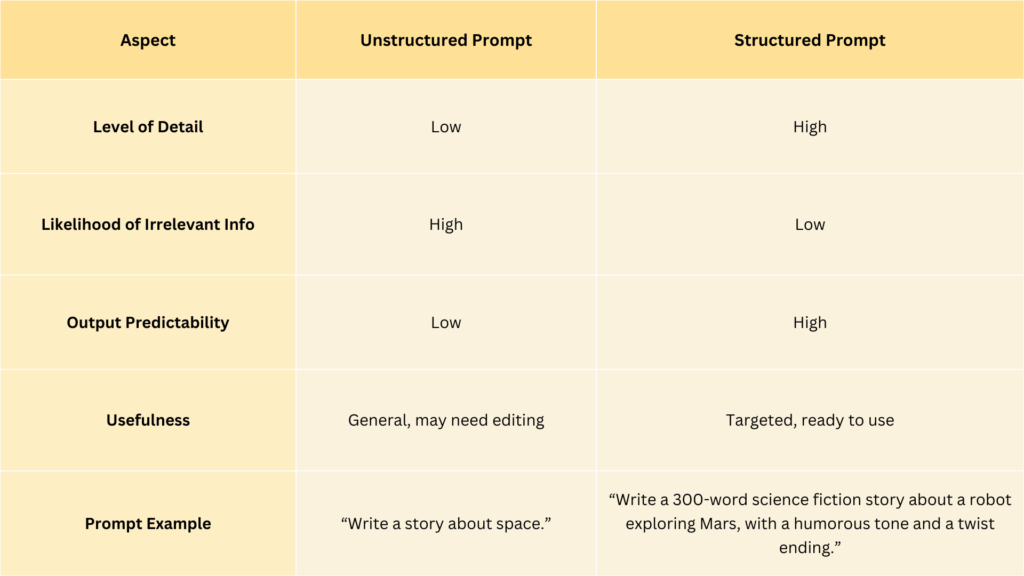
Why Structure Matters
Large Language Models (LLMs) like GPT are excellent at understanding context, but they aren’t mind-readers. Without clear instructions, the model often fills in gaps with assumptions, which can result in hallucinations, irrelevant tangents, or overly generic answers.
A well-structured prompt reduces this ambiguity and guides the AI toward producing exactly what you need. Think of it like giving instructions to a chef. Saying “Cook me something nice” could result in anything from a salad to pasta. You might end up with a dish you don’t like, perhaps because you’re vegetarian, allergic to certain ingredients, or simply don’t enjoy broccoli.


The more vague your instructions, the more the chef or in our case, the AI. It has to guess, which increases the chances of an unsatisfactory outcome.
Now, imagine giving clear, detailed instructions: “Cook me a vegetarian pasta with garlic, basil, and cherry tomatoes, no broccoli, and make it suitable for a quick 20-minute meal.” The chef knows exactly what you want and can deliver a result that matches your expectations. The same principle applies to AI prompts. Structured prompts give the model the context, constraints, and desired format, which reduces ambiguity and produces more accurate and relevant outputs.
Core Principles of Structured Prompts
To understand the difference between a structured and an unstructured prompt, it is important to first know the core principles of a structured prompt. Writing a structured prompt is not just about making it longer or using perfect grammar. Structured prompts help the AI give responses that are accurate, relevant, and useful. They reduce confusion, guide the AI step by step, and save time by minimizing the need for corrections.
The main principles of a structured prompt include removing ambiguity, breaking down large tasks, using formatting to your advantage, and testing and iterating your prompts. By following these principles, you can guide the AI to produce outputs that are much closer to what you want. Whether you are generating text, solving problems, analyzing data, or creating content, applying these core principles will help you get precise, reliable, and effective results from any AI model.
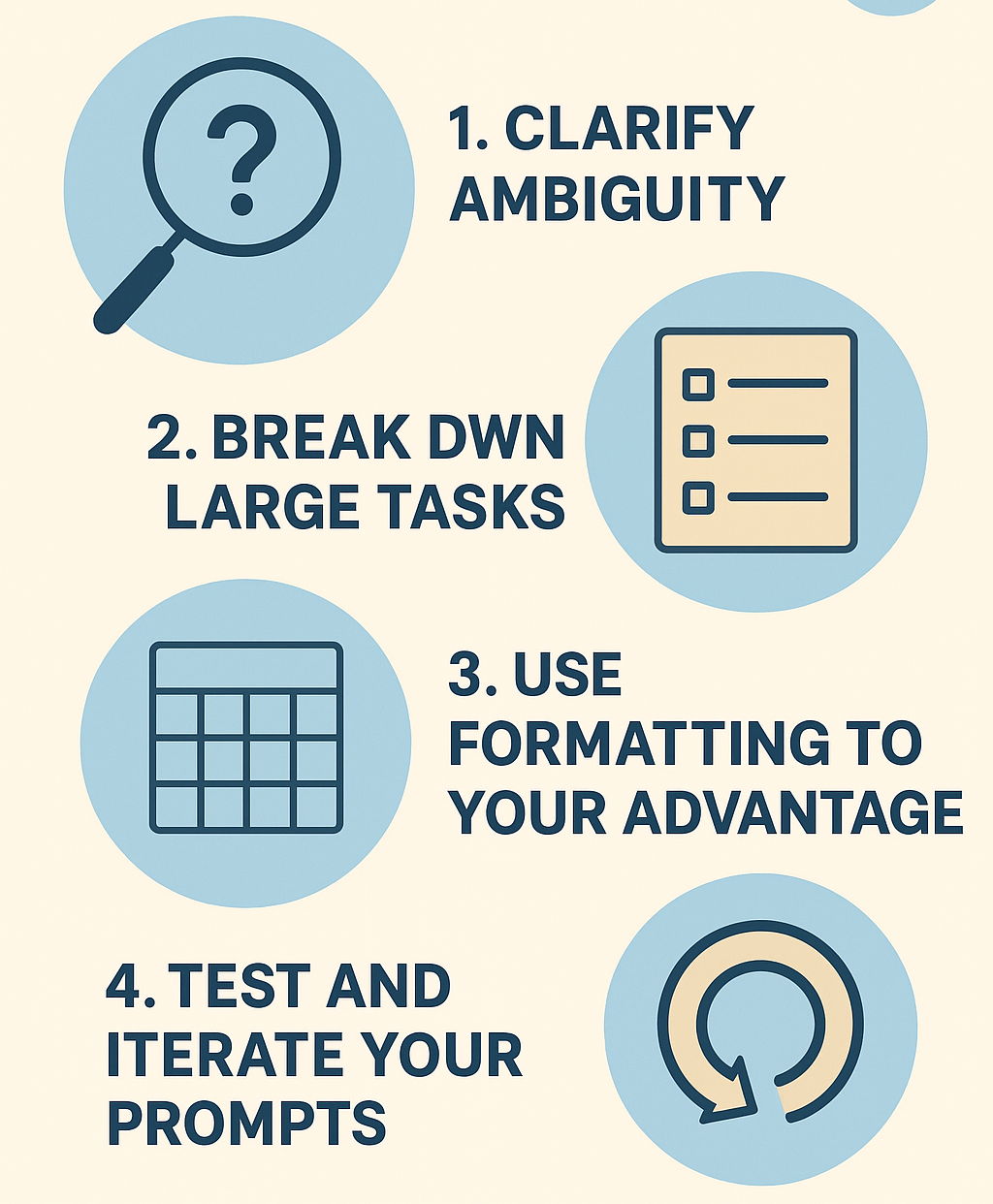
Clarify Ambiguity
Unclear or vague wording is one of the biggest reasons AI produces poor outputs. When a prompt leaves too much to the model’s imagination, the result can be generic, irrelevant, or even incorrect. The key is to provide specific instructions that clearly define what you want.
For example, instead of asking, “Tell me about climate change.” Try asking, “Summarize the causes of climate change in three bullet points, focusing on human impact.”
Here, the revised prompt sets boundaries: it specifies the format (three bullet points), the focus (human impact), and the type of information required (causes). By removing ambiguity, you guide the AI and reduce guesswork, increasing the likelihood of a precise and useful response.
Tips:
- Include the type of output (summary, list, report, explanation)
- Specify the focus or perspective (historical, scientific, business, personal)
- Limit or guide the scope to avoid overly broad answers
Break Down Large Tasks
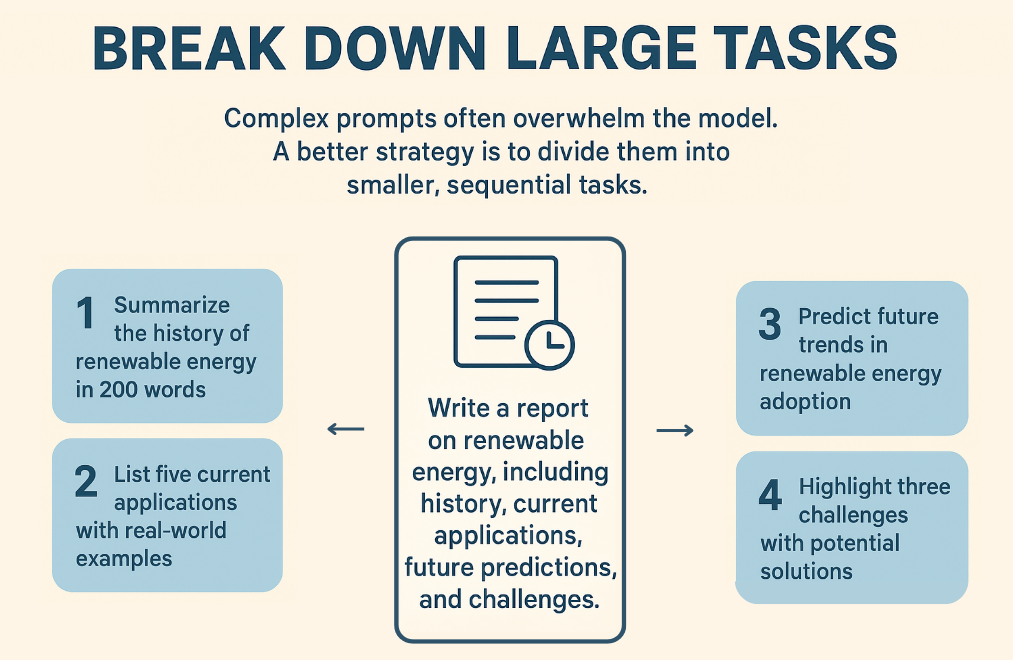
Large or complex prompts can overwhelm AI models, resulting in incomplete or scattered answers. A better strategy is to divide big tasks into smaller, sequential steps. This allows the AI to focus on one component at a time, producing modular outputs that are easier to review, refine, and combine.
For example, instead of asking, “Write a guide on starting a small business, covering planning, funding, marketing, and legal requirements.” Break it down into smaller tasks:
- “Summarize the key steps to plan a small business in 200 words.”
- “List three common ways to secure funding for a small business with examples.”
- “Provide five effective marketing strategies for a new small business.”
- “Explain the main legal requirements to start a small business in India.”
This approach produces structured, digestible results and gives you more control over the content. You can refine each part individually before combining them into a complete guide.
Tips:
- Start with simpler tasks before asking for complex analysis
- Use sequential prompts to gradually build the final output
- Review each step to ensure accuracy before moving on
Use Formatting to Your Advantage
AI models perform better when the desired format is clearly defined. You can guide the model to structure the output in ways that are easy to read, analyze, and use. Common formats include:
- Lists: Great for concise, scannable information
- Tables: Ideal for comparisons or structured data
- Code blocks: Useful for technical clarity or reproducible outputs
For example: “Compare solar, wind, and hydro energy in a table with columns for cost, reliability, and scalability.”
This prompt tells the AI exactly how to organize the information, which reduces misinterpretation and produces results that are immediately useful. Clear formatting also makes it easier to integrate AI output into reports, presentations, or further analysis.
Tips:
- Specify headings, bullet points, or numbering if needed
- Use tables for structured comparisons
- Use code blocks for formulas, scripts, or technical outputs
Test and Iterate Your Prompts
Prompting is an iterative process. Even well-structured prompts may need refinement. Small adjustments in wording, focus, or format can lead to better results. Think of it like debugging code: each run reveals what works and what does not.
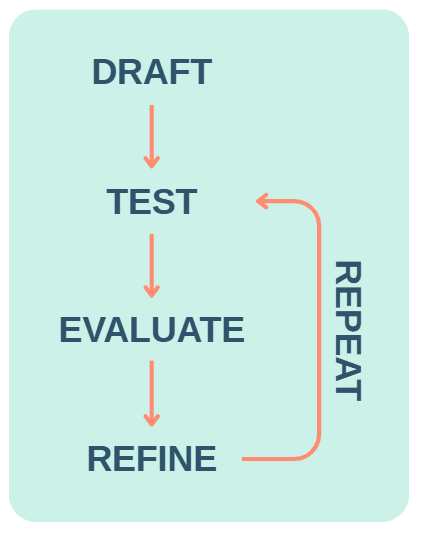
For example: if a prompt produces too much detail or misses key points, try:
- Changing the output length (“in 150 words” instead of “briefly”)
- Adjusting the focus (“emphasize environmental impact”)
- Providing an example to guide style or tone
Over time, testing and iterating will help you understand how the AI responds to different instructions and enable you to consistently produce high-quality outputs.
Tips:
- Keep track of effective prompts for future use
- Experiment with variations of the same prompt
- Compare multiple outputs before choosing the best one
Did you Know?
Well-structured prompts can improve AI output accuracy by up to 50% compared to vague prompts.
Accuracy doesn’t come from complexity, it comes from structure. By clarifying ambiguity, breaking tasks into manageable chunks, using formatting, and iterating thoughtfully, you can consistently guide AI toward precise, reliable outputs. Mastering this skill transforms you from a casual user into a confident prompt engineer.