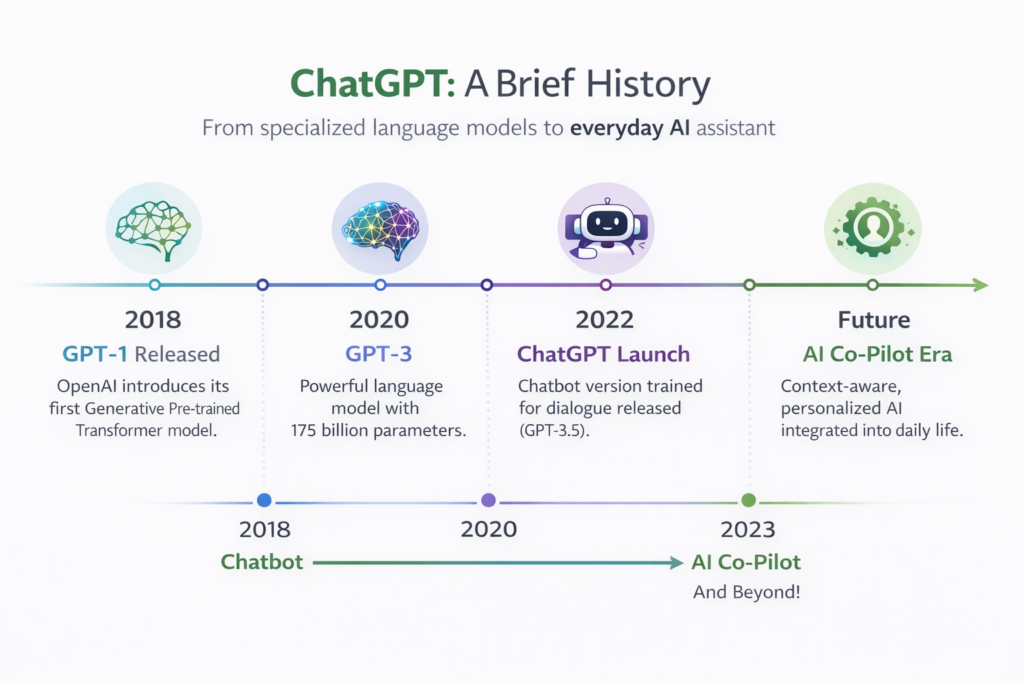
ChatGPT is an AI-powered chatbot developed by OpenAI, launched to the public in November 2022. it is built on a family of large language models (LLMs) called GPT which stands for Generative Pre-trained Transformer. In plain English, it is a very sophisticated text-based AI that can hold conversations, answer questions, write content, debug code, and a whole lot more.
Think of it as a highly knowledgeable assistant that has read an enormous chunk of the internet and learned to respond in natural, human-like language. It does not “think” the way humans do, but it is remarkably good at predicting what a helpful, coherent response should look like based on the context you give it.
Did You Know?
The “T” in GPT stands for Transformer. It is a neural network architecture introduced by Google researchers in a 2017 paper titled “Attention Is All You Need.” OpenAI took that architecture and scaled it to an almost unimaginable degree.
Fun Fact!
ChatGPT reached 100 million users in just 2 months, the fastest any consumer app has ever hit that milestone. For comparison, Instagram took 2.5 years, and Netflix took over a decade.
How to Use ChatGPT
Getting started is simple:
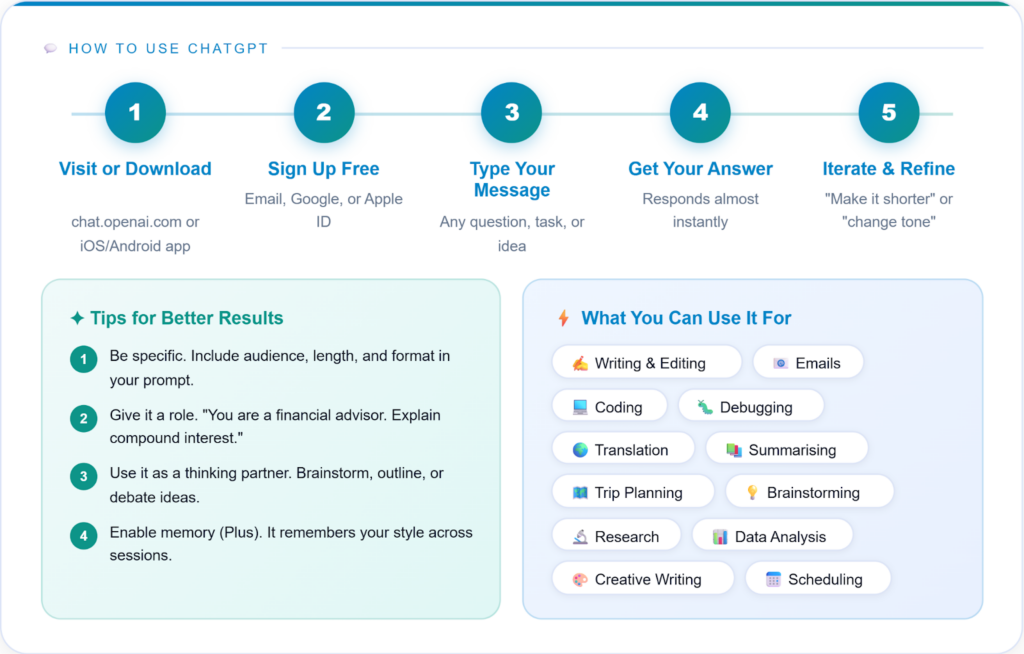
- Go to chat.openai.com or download the ChatGPT app (iOS/Android).
- Sign up for a free account using your email, Google, or Apple ID.
- Type your message in the chat box and hit Enter.
- That’s it. ChatGPT will respond almost instantly.
Tips for Getting Better Results
- Be specific. Instead of “Write me something about dogs,” try “Write a 200-word fun fact article about Golden Retrievers for kids aged 8–10.”
- Give it a role. “You are a financial advisor. Explain the concept of compound interest simply.”
- Iterate. If the first response is not quite right, tell it what to change like “Make it shorter,” “use a more casual tone,” or “add more examples.”
- Use it as a thinking partner. You can brainstorm, outline, debate ideas, or rubber-duck your way through a problem.
- Use memory to your advantage. ChatGPT Plus users can enable memory so the model remembers your preferences, writing style, and recurring context across sessions.
What You Can Use It For
Writing and editing (emails, essays, cover letters, blog posts), summarizing long documents, coding help and debugging, learning new topics quickly, translating languages, generating ideas, answering research questions, planning trips or schedules, the list goes on. If it involves language, there’s a good chance ChatGPT can help.
Strengths
- Conversational fluency: ChatGPT holds context across a conversation and responds in natural, readable language. It does not feel like talking to a search engine.
- Versatility: It can switch from writing a haiku to explaining quantum mechanics to helping you debug a Python script, all in the same session.
- Speed: Responses arrive in seconds, making it far faster than traditional research or drafting.
- Accessibility: The free tier is genuinely useful, making powerful AI available to almost anyone with internet access.
- Coding assistance: Developers use it heavily for writing boilerplate code, spotting bugs, explaining error messages, and learning new languages or frameworks.
- Tone flexibility: Ask it to be formal, casual, funny, academic, or empathetic. It adapts well.
Fun Fact!
ChatGPT can pass the US Bar Exam, the SAT, and various medical licensing exams, scoring in the top percentile on many of them. It passed the US Medical Licensing Exam without any special training for it whatsoever.
Limitations
- It can confidently be wrong: This is arguably its biggest flaw. ChatGPT can produce false information with the same confident tone it uses for accurate facts. This is called a “hallucination.” Always fact-check important claims, especially for anything medical, legal, or financial.
- Knowledge cutoff: GPT-4’s training data has a cutoff date, meaning it does not know about recent events unless it has access to browsing tools.
- No real understanding: ChatGPT does not actually “know” anything, it predicts plausible text based on patterns. It has no lived experience, opinions, or true comprehension.
- Inconsistency: You can ask the same question twice and you might get two different answers. Responses can vary in quality.
- Struggles with complex math and logic: Intricate multi-step reasoning can still trip it up. Always verify calculations independently.
- Context window limits: Very long conversations may cause it to “forget” earlier parts of the chat, leading to contradictions or loss of nuance.
- Bias: Like all models trained on human-generated data, it can reflect biases present in that data, sometimes in subtle and hard-to-spot ways.
Did You Know?
ChatGPT has a hidden “system prompt,” a set of instructions OpenAI feeds it before you ever type a word. It shapes how the model behaves, what it will and will not say, and its overall personality. You never see it, but it is always there in the background.
ChatGPT for Work and Productivity
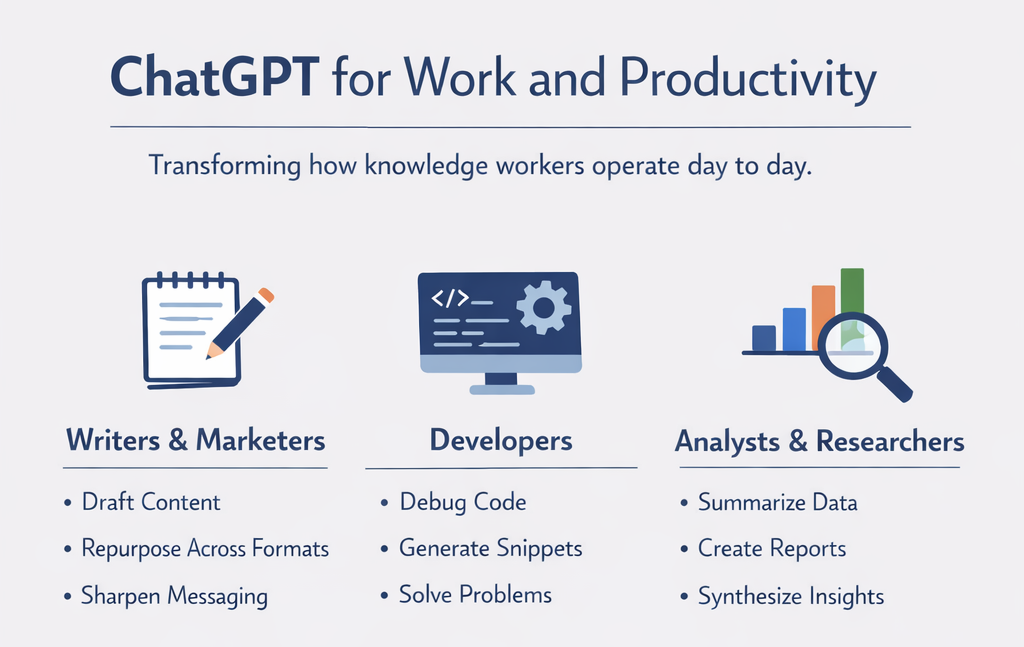
One of the most significant shifts ChatGPT has caused is in how people approach professional tasks. it has become a quiet but powerful layer in how many knowledge workers operate day to day.
Writers and marketers use it to overcome blank-page paralysis, draft first versions, repurpose content across formats, and sharpen messaging. Developers treat it like a pair of programmers, someone to bounce ideas off, catch bugs with, and look up syntax they have not touched in months. Analysts and researchers use it to quickly synthesize information, draft summaries, and turn data into readable narratives.
One important note: ChatGPT works best as a collaborator, not a replacement. The people who get the most out of it are those who bring their own judgment, expertise, and critical eye to the table and use ChatGPT to go faster, not to skip thinking altogether.
Fun Fact!
ChatGPT has been used to write entire screenplays, wedding speeches, legal briefs, and research papers, sometimes without the reader ever knowing. This has sparked ongoing debates in academia, law, and journalism about transparency and authenticity.
Privacy and Safety: What You Should Know
When you use ChatGPT, your conversations may be used by OpenAI to improve its models unless you opt out in your account settings. It is worth being thoughtful about what you share. Avoid inputting sensitive personal information, proprietary business data, or confidential details you would not want stored on a third-party server.
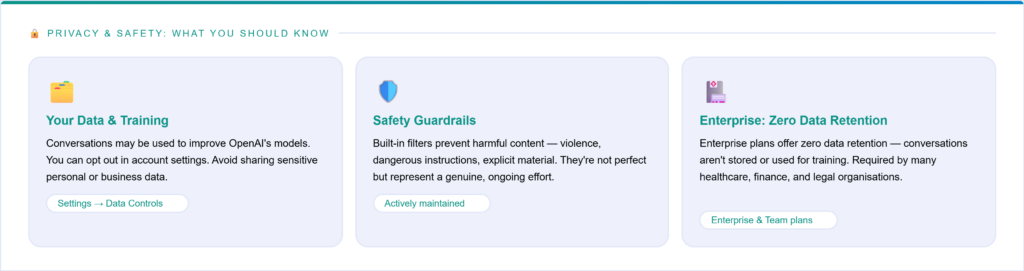
OpenAI has built in a range of safety guardrails to prevent the model from producing harmful content such as instructions for violence, explicit material, or detailed guidance on dangerous activities. These filters are not perfect, and a small community of users constantly tests their limits, but they represent a genuine and ongoing effort.
For enterprise users, OpenAI offers a Zero Data Retention option, meaning conversation data is not stored or used for training. Many companies operating in regulated industries like healthcare, finance, and legal require this before deploying AI tools internally.
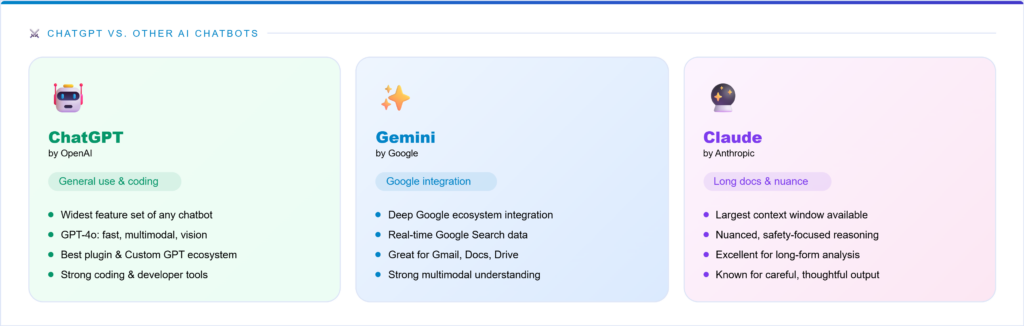
The Bigger Picture
ChatGPT did not just launch a product, it launched a cultural conversation about the future of work, creativity, education, and what it means to be human in an age of intelligent machines. Whether you use it daily or remain skeptical, it is hard to argue that it has not changed things.
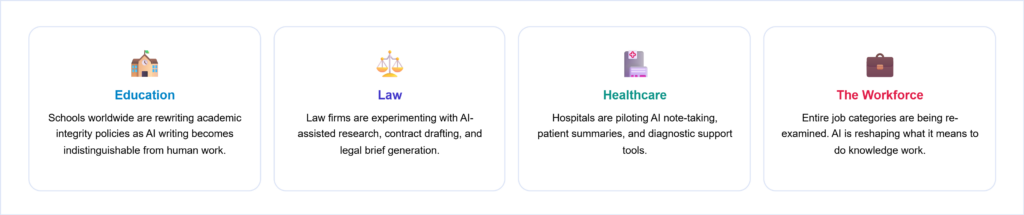
Schools are rewriting academic integrity policies. Law firms are experimenting with AI-assisted research. Hospitals are piloting AI note-taking tools. Entire job categories are being re-examined. None of this started with ChatGPT, but ChatGPT made it impossible to ignore.
The technology is still evolving rapidly. What feels impressive today will likely seem modest in a few years. But right now, for anyone willing to learn how to use it well, ChatGPT is one of the most powerful productivity tools available that is free of charge, available 24/7, and inexhaustible in its patience.
Just remember to always double-check its work.