Artificial Intelligence (AI) is quickly becoming an integral part of our everyday lives from writing articles, assisting with coding, analyzing data, and even generating art. However, while AI systems are incredibly powerful, they are not mind readers. They depend entirely on the instructions we provide. Just like a search engine gives poor results when asked vague questions, AI models also fail to deliver if the input isn’t clear.
This is where prompt engineering comes in. It is the skill that transforms AI from a generic assistant into a specialized, reliable tool. But before we dive into prompt engineering, let’s start with the most fundamental concept: the prompt itself.
What is a Prompt?
A prompt is any input given to an AI model that guides its response. It can be:
- A question: “What is the capital of France?”
- A command: “Write a formal email requesting a project deadline extension.”
- A scenario or role: “Act as a travel agent and suggest a 3-day trip itinerary for Rome.”
In short, a prompt is the bridge between human intent and machine output.
Think of prompts like instructions you give a chef:
- If you simply say, “Cook something,” the chef might bring you any random dish.
- If you say, “Prepare a spicy vegetarian curry with chickpeas and serve it with rice,” the chef knows exactly what to do.
The more clear, structured, and contextual the prompt, the better the output.
Fun Fact
Early AI researchers in the 1960s used carefully crafted text inputs to get programs like ELIZA to respond convincingly. Read More
What is Prompt Engineering?
Prompt engineering is the practice of designing, testing, and refining prompts to maximize the quality of AI responses. It is both an art and a science:
- Art, because it requires creativity in phrasing and context setting.
- Science, because it involves systematic testing, structure, and iteration to optimize results.
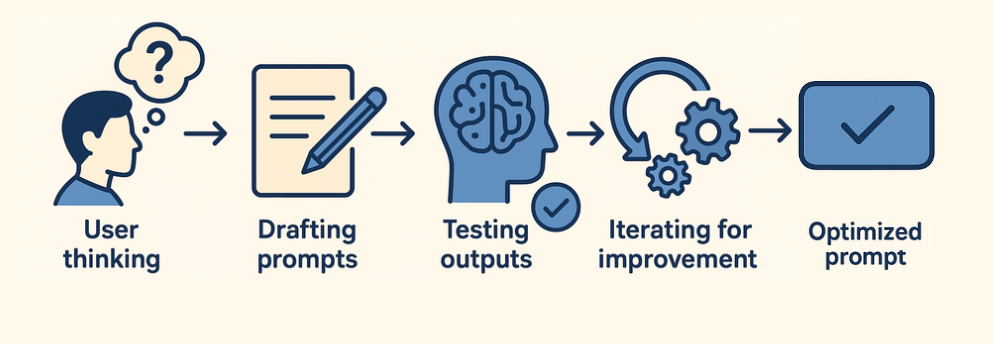
The process typically begins with a need or task, which is then expressed as an initial prompt. The AI generates a response, and based on how well it meets expectations, the prompt is refined. This cycle of drafting, testing, and improving continues until the instructions are optimized ensuring the AI produces detailed, accurate, and creative outputs.
Prompt engineering is essential because, at the end of the day, AI is a tool. Its effectiveness depends entirely on the clarity of our instructions. If we don’t prompt well, the model cannot provide the level of precision or usefulness we expect.
Why Prompt Engineering Matters as AI Grows
As AI tools spread across industries, mastering prompt engineering becomes a critical skill:
- AI is only as good as the input. A vague or sloppy prompt produces vague, sometimes misleading results.
- AI is a multiplier. If used well, it accelerates productivity and creativity; if used poorly, it wastes time.
- AI is universal. From business to art to education, every field can leverage better prompts for better outcomes.
In other words, learning how to communicate with AI effectively is like learning how to use a new language of productivity.
Good vs. Bad Prompts
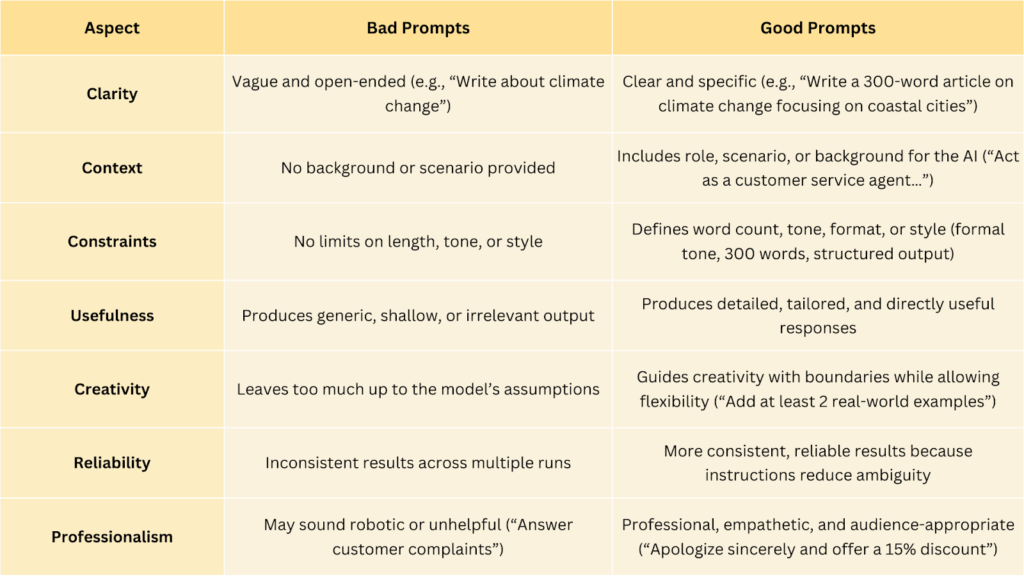
The way you ask the AI a question makes a big difference in the answer you get. If a prompt is unclear or too short, the response will usually be vague or unhelpful. But when the prompt is clear, detailed, and gives enough context, the AI can produce much better results. Here are some examples to show the difference between bad and good prompts.
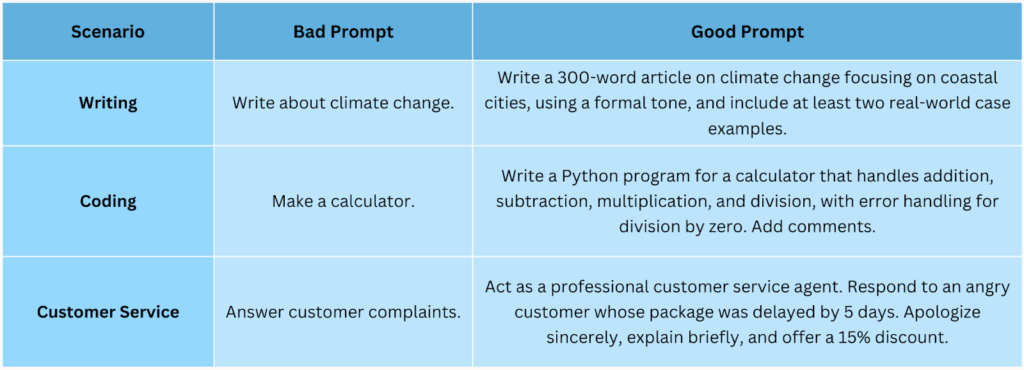
Example 1: Writing
- Bad Prompt: “Write about climate change.”
Output: A short, generic explanation with little depth.
- Good Prompt: “Write a 300-word article on climate change focusing on its impact on coastal cities, using a formal tone, and include at least two examples of real-world cases.”
Output: A detailed, structured, and context-rich article.
Example 2: Coding
- Bad Prompt: “Make a calculator.”
Output: AI may generate incomplete or overly simplistic code.
- Good Prompt: “Write a Python program for a calculator that can handle addition, subtraction, multiplication, and division, with error handling for division by zero. Include comments explaining each function.”
Output: Clean, functional, and well-documented code.
Example 3: Customer Service
- Bad Prompt: “Answer customer complaints.”
Output: Generic and robotic responses. - Good Prompt: “Act as a professional customer service agent. Respond to an angry customer whose package was delayed by 5 days. Apologize sincerely, explain the delay briefly, and offer a 15% discount on their next purchase.”
Output: Empathetic, professional, and solution-focused response.
Importance of Prompt Engineering Across Fields
Across all fields, the difference between mediocrity and excellence comes down to how prompts are engineered.
Did you Know?
Major tech companies including Google, Microsoft, Amazon, and Meta are actively hiring Prompt Engineers, with salary ranges typically spanning $110,000 (90 lakhs) to $250,000 (2.07 crores) per year. Read More
- Business
- Marketing teams use it to generate tailored ad copy.
- HR uses prompts for structured job descriptions or candidate screening.
- Customer support builds clear, empathetic responses.
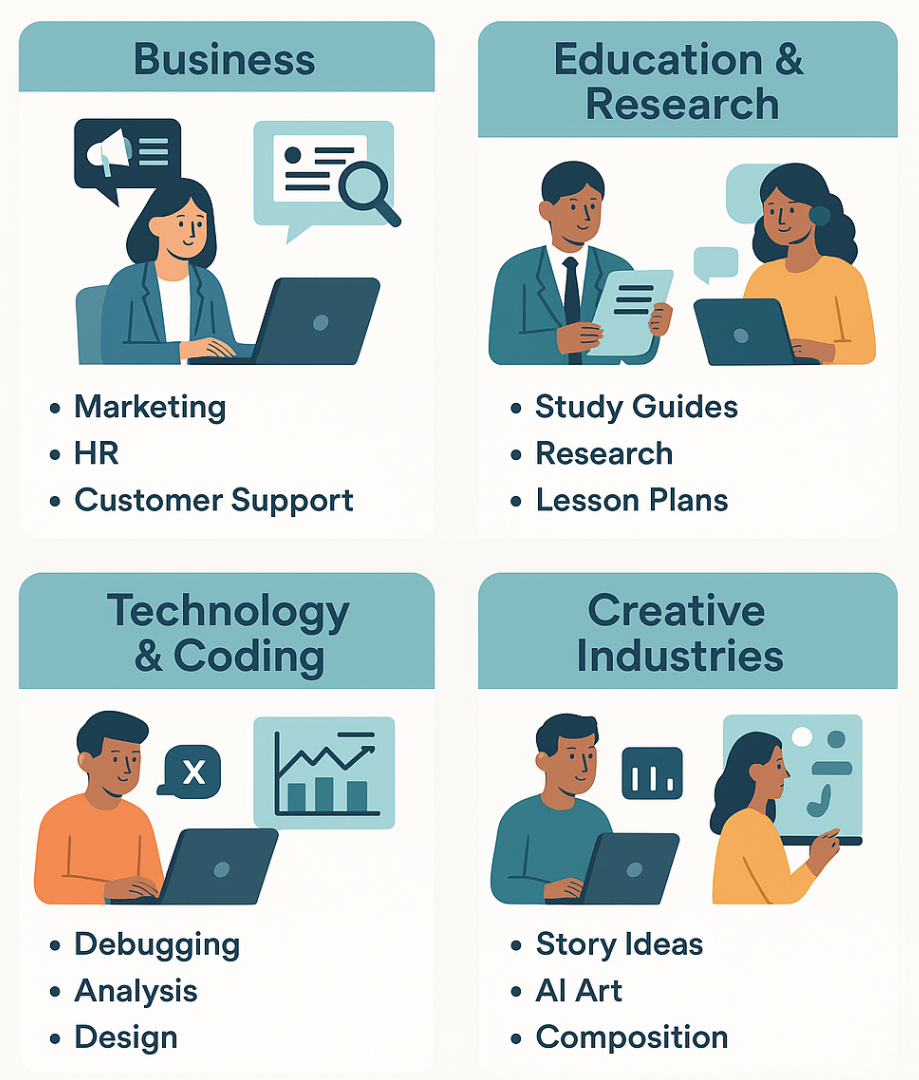
- Education & Research
- Students can generate study guides or practice questions.
- Researchers can summarize papers or compare methodologies.
- Educators can create lesson plans adapted to different learning styles.
- Technology & Coding
- Developers debug code by giving precise bug descriptions.
- Analysts summarize datasets or generate SQL queries.
- Engineers test design concepts quickly with prompt iterations.
- Creative Industries
- Writers generate story ideas, dialogue, or world-building elements.
- Designers create AI-generated art with carefully phrased prompts.
- Musicians experiment with AI-assisted composition.
Common Misconceptions About Prompt Engineering
- “It’s just asking questions.”
Reality: Crafting prompts involves strategy, testing, and refinement. - “AI understands everything automatically.”
Reality: AI doesn’t “understand” like humans—it predicts based on patterns, making clarity essential. - “Prompts don’t need practice.”
Reality: Like coding, prompt engineering is a skill that improves with experimentation.
As AI grows more powerful and more common, prompt engineering is becoming a universal skill, much like email or search engines once were. Those who learn it early will have a significant advantage in efficiency, creativity, and problem-solving.
Think of prompt engineering as learning to give directions to the smartest assistant in the world but one who only follows instructions as given. If the directions are sloppy, the outcome is disappointing. If the directions are clear, structured, and thoughtful, the results can be extraordinary.