
Have you ever asked an AI something simple like “Write me a short story about a dolphin,” only to get a dull, generic paragraph that barely qualifies as a story? Or maybe you asked for help with a coding bug and the answer left out the exact part you were struggling with. These experiences aren’t failures of AI intelligence. They’re often the result of how the question was asked.
This is where prompt engineering comes in. Prompt engineering is an art and a science, and it’s the difference between vague, unhelpful AI output and a clear, actionable response.
While today’s AI systems are advanced, they are still machines. They don’t “understand” your intentions beyond the words you type, they work purely on the instructions you give them. If the instructions are weak, the output will be weak. If the instructions are strong, structured, and detailed, the output can be surprisingly accurate and creative.
Why Prompt Structure Matters
Think of prompting as giving directions. If you tell someone, “Go to the store,” they might bring back anything. If you say, “Go to the store and bring me two loaves of whole-wheat bread, sliced,” the result is far closer to what you need. AI works the same way: precision in instructions leads to precision in results.
A good prompt doesn’t just tell the AI what to do, it sets the context, provides constraints, defines the tone and style, and sometimes even assigns a persona. This structured approach transforms your interaction with AI from guesswork into a guided collaboration.
Core Elements of a Good Prompt
A well-designed prompt is made up of several building blocks. Mastering each one gives you more control over the output and makes the AI act like a true collaborator instead of a random answer generator. The 5 core elements of a good prompt are instructions, context, constraints, Persona and last but not least tone and style. Together, these five elements make prompts more structured, reliable, and powerful. They’re not rules you must always use, but tools you can combine depending on your needs.
Instructions: The Command
Instructions are the specific task you’re asking the AI to perform. It should be clear, actionable, and goal-oriented.
Why it matters: Without clear instructions, AI defaults to general answers. Ambiguity creates weak, generic outputs.
Common Mistakes:
- Using vague verbs like “talk about” or “tell me”.
- Leaving the purpose unstated.
- Expecting the AI to “know what you mean.”
How to do it right:
- Weak: “Explain photosynthesis.”
- Strong: “Explain photosynthesis in simple terms suitable for a 10-year-old, using a step-by-step approach.”

AI Tip:
Start with action verbs like explain, summarize, generate, write, compare, list, analyze, or design. This frames the task clearly.
Context: Setting the Scene
Context is the background information that guides the AI to produce relevant and audience-appropriate answers.
Why it matters: AI can only work with what you provide. Without context, it fills gaps with assumptions, which may not match your intent.
Common Mistakes:
- Asking for a summary without saying who it’s for.
- Leaving out the background that would shape tone or depth.
- Providing too much irrelevant detail that distracts the AI.
How to do it right:
- Weak: “Summarize this article.”
- Strong: “Summarize this research article for business executives who have no background in biology, focusing only on key takeaways relevant to management decisions.”
AI Tip:
Always mention audience (“for students,” “for executives”), purpose (“for a blog,” “for training”), or scenario (“as preparation for an interview”).
Constraints: Rules and Boundaries
Constraints set the limits you set on how the answer should look: word count, format, structure, or scope.
Why it matters: Constraints prevent wandering answers and ensure usability. Without them, outputs may be too long, too vague, or stylistically off.
Common Mistakes:
- Not setting a length: AI might write pages when you want a paragraph.
- Not specifying a format: Output might be prose when you need bullet points.
- Forgetting scope: AI might include irrelevant details.
How to do it right:
- Weak: “Write about social media marketing.”
- Strong: “Write a 200-word blog post in a humorous tone, broken into 3 short paragraphs, explaining why small businesses should use Instagram for marketing.”
AI Tip:
Add measurable rules like “200 words,” “5 bullet points,” “2 examples,” “table format.” These tighten output.
Tone & Style: Shaping the Voice
Tone and Style are the emotional and stylistic layer of the response: serious, playful, professional, persuasive, casual, etc.
Why it matters: Tone makes AI sound like you want it to sound. The same information in a legal tone vs. a friendly tone feels completely different.
Common Mistakes:
- Forgetting to specify tone: AI defaults to neutral, textbook-like answers.
- Overloading with multiple conflicting tones (e.g., “funny but also formal and serious”).
- Using vague instructions like “make it better.”
How to do it right:
- Weak: “Give me a pep talk.”
- Strong: “Act as a motivational coach. Write a short, punchy pep talk for students the night before exams, using encouraging and energetic language.”
AI Tip:
Use tone markers like formal, casual, empathetic, humorous, persuasive, poetic, or motivational. If you don’t tell the AI how to “sound,” it won’t guess right.
Persona (Role Assignments): Giving the AI a Role
Persona refers to assigning the AI a perspective or identity, like “lawyer,” “teacher,” “journalist,” or “travel guide.”
Why it matters: It frames the AI’s response style and content. A cybersecurity expert explains differently than a children’s storyteller.
Common Mistakes:
- Forgetting to assign a role: Output sounds generic and lacks authority.
- Assigning conflicting roles (e.g., “be a lawyer and a poet at the same time”).
- Overcomplicating the persona (“act like Einstein with the humor of Seinfeld and the tone of a therapist”).
How to do it right:
- Weak: “Explain password safety.”
- Strong: “Act as a cybersecurity expert. Explain the risks of weak passwords to a startup team in plain English, with one real-world hacking example.”
AI Tip:
Personas aren’t just for expertise, they can also spark creativity (“act as a pirate,” “act as Shakespeare”) or simplify tone (“act as a kindergarten teacher”).
Weak vs. Strong Prompts
When you compare weak and strong prompts, the differences are not just in length but in clarity, structure, and impact. Simply writing a longer prompt will not make it better. It needs to have the core elements and be clear, concise and relevant.
What Weak Prompts Do
- Leave the AI guessing about your intent.
- Produce generic, surface-level answers.
- Lack of audience awareness.
- Miss structure or format (harder to use).
- Provide limited creativity or focus.
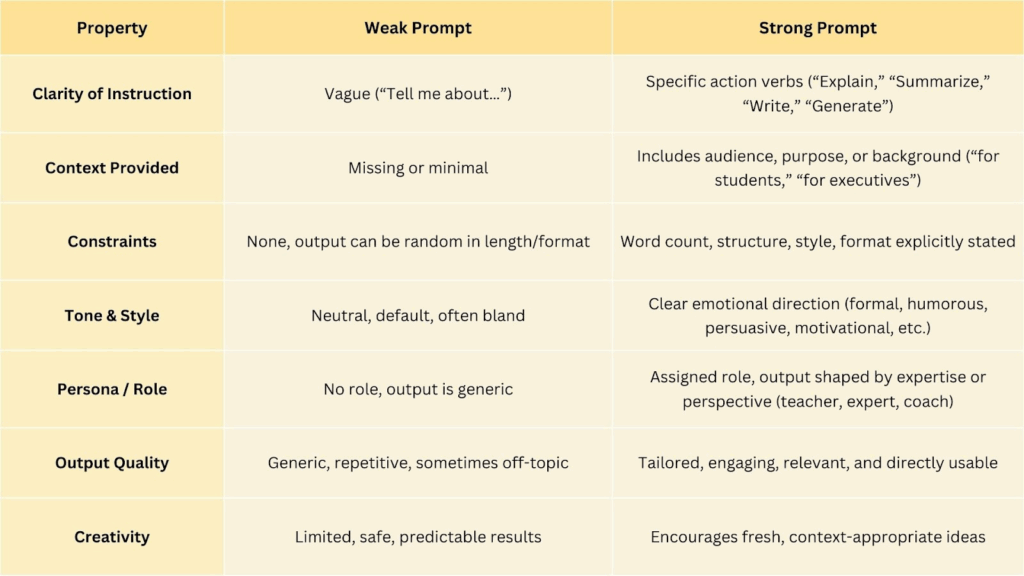
What Strong Prompts Do
- Give the AI clear, actionable instructions.
- Reduce ambiguity and assumptions.
- Adapt the response for a specific audience.
- Include constraints that shape length, tone, or format.
- Encourage creativity while staying relevant.
- Result in precise, useful, and engaging outputs.
For example:
Weak Prompt: “Hey, tell me about climate change and what it means.”
Strong Prompt: “You are a science communicator. Explain climate change to high school students in 4 paragraphs, using simple examples, one real-world case study, and a hopeful conclusion.”
The strong prompt is much better because it adds role, audience, format, and structure. This makes the output more clear, age-appropriate, engaging, and hopeful narrative.
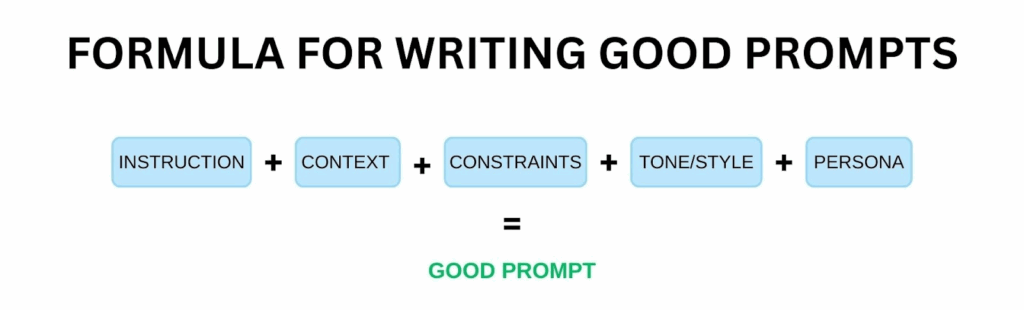
Strong prompts don’t just get you better AI responses, they train you to think with more clarity and intent. Every time you refine a prompt, you’re practicing the skill of framing problems and defining goals, skills that are valuable far beyond AI. As AI systems become partners in work, study, and creativity, prompt engineering is evolving into a fundamental literacy. If you can master the anatomy of a good prompt, you’ll not just use AI, you’ll guide it.