Imagine asking your phone about tomorrow’s weather, chatting with an AI that helps you write essays, or telling a virtual assistant to dim your lights, and it does it instantly. Not long ago, this would’ve sounded like science fiction. But today, talking to machines has become a part of everyday life.
Welcome to the world of Conversational AI, technology that allows computers to communicate with us in natural, human-like ways. From Alexa and Siri to ChatGPT and Google Assistant, conversational AI is changing how we interact with technology. It listens, understands, and responds almost like a friend. Whether it’s answering your questions, telling jokes, or helping you manage your day, AI that talks is quickly becoming one of the most personal and powerful tools of our time.
What is Conversational AI?
At its core, Conversational AI is a branch of artificial intelligence designed to enable machines to hold conversations with people through text, voice, or even video. It’s what powers chatbots, virtual assistants, and AI companions that can understand language, process emotions, and reply intelligently.
Simply put, it’s AI that talks and listens. Instead of typing commands or navigating menus, you can simply ask what you need and the AI replies just like a person would.
For example:
- Siri reminds you of appointments and sends messages.
- Alexa controls your smart home and plays your favorite music.
- ChatGPT helps you brainstorm ideas, write essays, learn new topics, or simply have a friendly chat.
- Google Assistant gives directions, checks traffic, and answers trivia questions.
This blend of convenience and human-like interaction is what makes conversational AI such a revolutionary technology.
How Does Conversational AI Work?
Though it seems effortless, every smooth conversation with AI involves several complex steps working behind the scenes. Conversational AI uses a combination of natural language processing (NLP), machine learning (ML), and speech recognition to understand what you say and respond appropriately.

- Input Processing: The system first receives your input, it could be a voice command (“Play my workout playlist”) or a text query (“What’s the weather today?”).
- Understanding (Natural Language Processing): The AI breaks down your words, analyzes grammar and intent, and determines what you’re really asking for.
- Thinking (Machine Learning & AI Models): Using patterns from past data and trained algorithms, the AI figures out the most relevant response or action.
- Responding (Natural Language Generation & Speech): Finally, it generates a natural, human-like reply — and if it’s a voice assistant, converts it into speech using text-to-speech technology.
For instance, when you say “Hey Google, find me the best pizza nearby”, Google:

- Recognizes your voice
- Understands you’re looking for nearby pizza places
- Checks local data and reviews
- Then replies, “I found a few pizza restaurants near you. The top-rated one is 5 minutes away.”
That’s conversational AI thinking, understanding, and talking back in real time.
Types of Conversational AI Tools
Conversational AI comes in many forms each designed for specific ways of communicating and problem-solving.
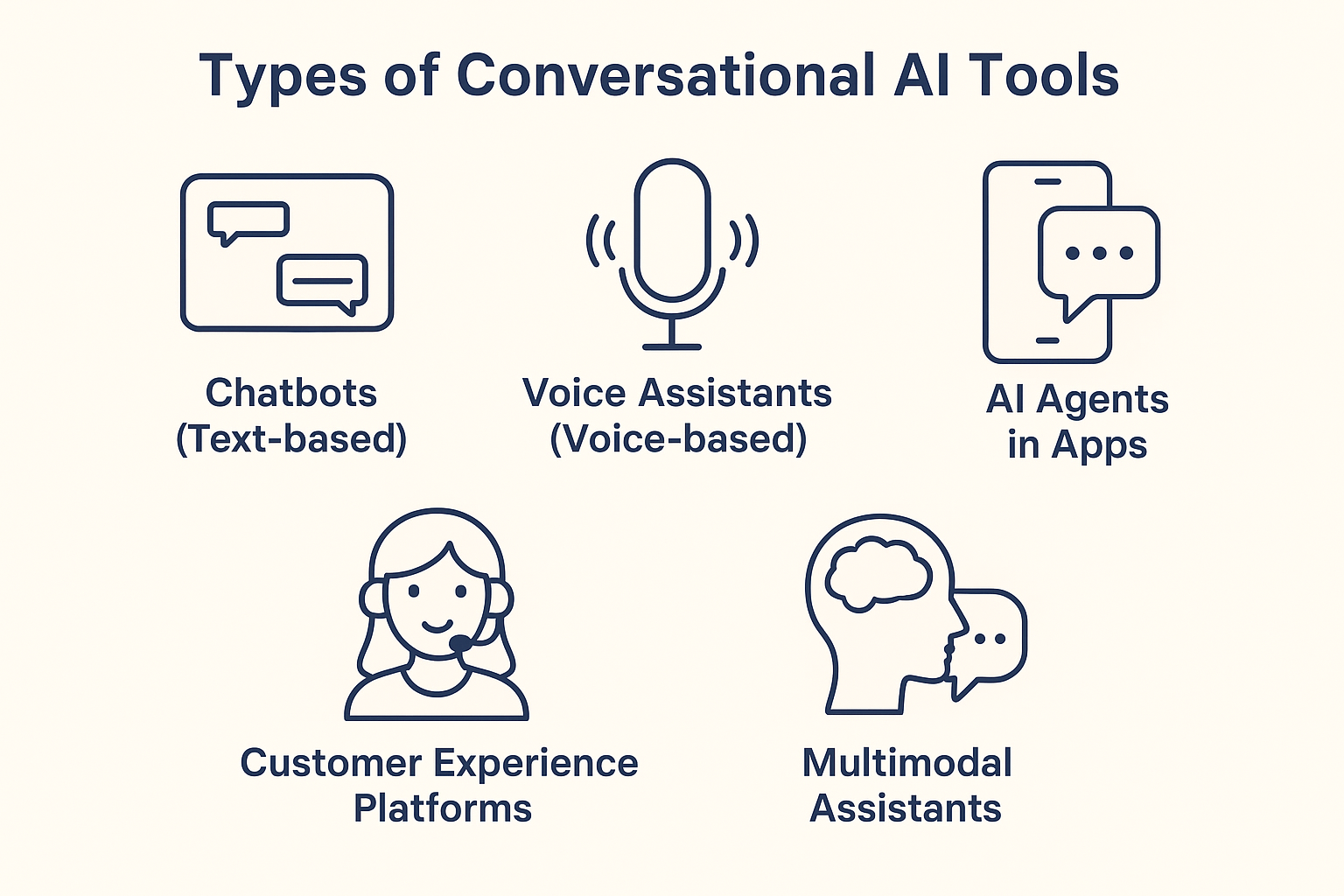
Chatbots (Text-based)
Found on websites and apps, chatbots assist users through text messages. They can help track orders, answer FAQs, or recommend products.
Example: The chatbot on an airline website that helps you change flight dates or check-in online.
Voice Assistants (Voice-based)
These are AIs you can literally talk to. Alexa, Siri, and Google Assistant are the most famous examples. They can play music, set reminders, answer questions, or even control smart home devices.
AI Agents in Messaging Platforms
Many companies now integrate conversational AI directly into chat apps like WhatsApp, Instagram, and Slack to help customers or teams interact faster.
Enterprise AI Platforms
Tools like IBM Watson Assistant, Dialogflow, or Microsoft Copilot are used by organizations to automate customer support, improve user experience, and reduce costs.
Multimodal Assistants
The newest generation, these can handle voice, text, and images all at once. For example, ChatGPT with voice and vision lets you talk naturally, show an image, and get explanations instantly.
Applications of Conversational AI
Conversational AI isn’t just about convenience, it’s transforming how entire industries operate.

Customer Service
Businesses use AI chatbots to answer questions 24/7, handle complaints, and even process refunds. Example: E-commerce chatbots that instantly check your order status or help you find the right size.
Healthcare
Virtual nurses, symptom checkers, and appointment schedulers assist patients in managing their health. Example: Babylon Health’s chatbot helps users describe symptoms and get medical guidance.
E-commerce
AI assistants make shopping personal. They recommend products based on your style and preferences. Example: H&M’s chatbot curates outfits by asking questions about your fashion taste.
Education
AI tutors and assistants help students study smarter and at their own pace. Example: Duolingo’s AI character that helps learners practice speaking a new language in real time.
Banking & Finance
Virtual banking assistants can check balances, analyze spending, and even suggest saving goals. Example: “EVA” by HDFC Bank provides customers with instant support and personalized financial insights through conversational AI.
Smart Homes
Voice assistants turn houses into responsive environments. You can control lights, appliances, and temperature just by speaking.
Entertainment & Companionship
Conversational AI is not just functional, it can be emotional too. Many people now chat with AI companions like Replika or ChatGPT, discussing daily life, getting advice, or simply having someone to talk to.
Fun Fact
The first ever “talking computer program” was ELIZA, developed in the 1960s at MIT. It simulated a psychotherapist and surprised its creator when users started forming emotional connections with it, believing it truly understood them!
Conversational AI has come a long way from ELIZA’s scripted responses to today’s intelligent, empathetic digital companions. What once felt like science fiction is now part of our daily routine, whether we’re asking Alexa for the news, chatting with Siri about reminders, or having a meaningful late-night conversation with ChatGPT about life, ideas, and creativity.
We no longer just use technology, we talk to it. And in many cases, it talks back with understanding, humor, and care. Conversational AI is shaping a world where communication with machines feels more natural, more personal, and more human than ever before.
As these systems continue to learn, the line between human and machine conversation will keep blurring, opening doors to a future where your next best friend, teacher, or advisor might just be powered by AI.