Generative Artificial Intelligence, often called Generative AI, is one of the fastest-growing areas in technology today. Unlike traditional AI systems that mainly analyse or classify information, Generative AI goes a step further and can create new content. From writing human-like stories and producing realistic images to composing music or generating short videos, this technology is unlocking creative possibilities once limited to human imagination.
Think of it as a computer that does not just follow instructions but acts like a creative partner. It can write a poem, paint a picture, compose a tune, or even design a video game character. By learning from vast amounts of data, Generative AI is able to generate original outputs that feel fresh, surprising, and often inspiring.
Did you Know?
The first form of “AI art” dates back to the 1960s, when computers were used to generate simple line drawings!
How Generative AI Differs from Traditional AI
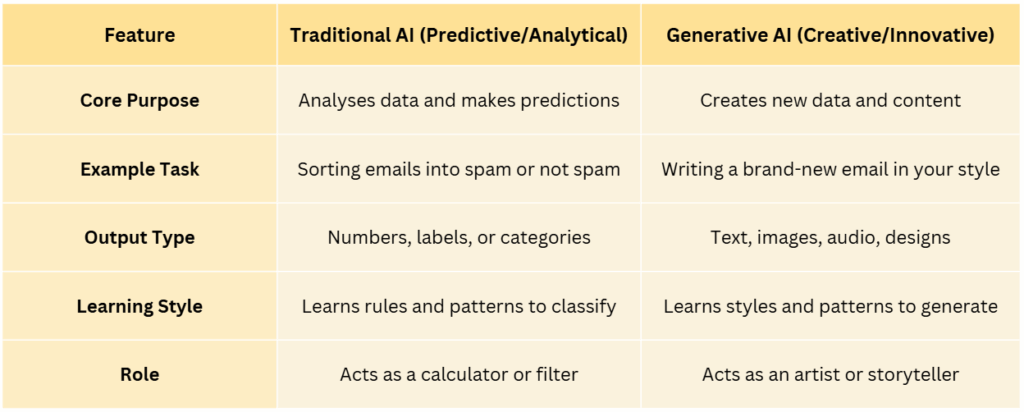
Traditional AI is like a skilled calculator. It takes information, analyses it, and gives you a result. For example, a spam filter in your email looks at incoming messages and decides whether they are junk or safe. It does not “create” new emails, it only classifies.
Generative AI, on the other hand, is like an imaginative artist. If you give it a short prompt such as “Write a bedtime story about a robot in the jungle,” it does not just pick from a list of ready-made stories. Instead, it creates a brand new story based on what it has learned from reading thousands of books, stories, and patterns in language. This ability to create rather than just recognise is what makes Generative AI stand out.
Imagine you are planning a school play.
- If you ask traditional AI to help, it can check past plays and tell you which ones were most popular.
- If you ask Generative AI, it can write you a brand-new script about a dragon who learns to dance, complete with dialogue and stage directions.
This shows how one focuses on analysing, while the other focuses on creating.
Where Does Generative AI Fit in AI?
Artificial Intelligence (AI) is the broad field of making machines think and act intelligently. Within AI lies Machine Learning (ML), which enables machines to learn patterns from data instead of being programmed step by step. A more advanced part of ML is Deep Learning (DL), where systems use artificial neural networks inspired by the human brain to process enormous amounts of information.

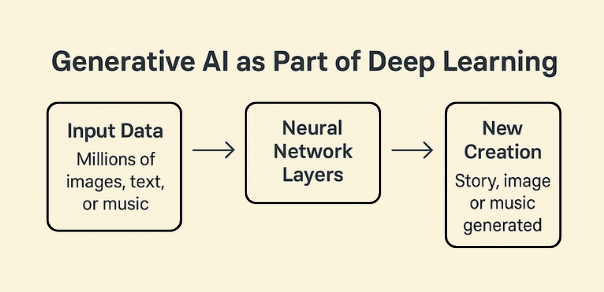
Generative AI is a subset of Deep Learning. While many Deep Learning systems are designed for recognition such as identifying faces in photos or detecting spam in emails. Generative AI focuses on creation. It produces new data that looks, sounds, or reads like the data it was trained on.
These neural networks are trained on massive datasets. For example, millions of songs, books, or images. Once trained, the AI does not simply memorise. Instead, it learns the underlying patterns, styles, and structures in the data. Later, it can use this knowledge to generate something entirely new.
For instance, if a Generative AI is trained on a vast collection of paintings, it does not copy them directly. Instead, it understands the use of colours, shapes, and brush strokes across different artists. As a result, it can create a painting in the style of Van Gogh or Picasso, even though that specific artwork never existed before. This ability to understand and imitate style is what makes Generative AI both powerful and fascinating.
How Does Generative AI Work?
Generative AI models are trained on massive datasets of text, images, sounds, or videos. By studying millions of examples, the AI learns the patterns, styles, and structures behind human creativity. Later, when a user gives the AI a prompt (an instruction), it uses these learned patterns to create original outputs.
For example:
- If trained on novels, it can write a short story when given a starting line.
- If trained on millions of images, it can generate a completely new picture when given a description like “a futuristic city under the ocean.”
- If trained on music, it can compose a fresh tune in the style of jazz or classical.
A key driver of this technology is the Large Language Model (LLM), which processes and generates text. These models, such as GPT (Generative Pre-trained Transformer), are able to predict the next word in a sentence so well that the writing feels natural and human-like. Similarly, image models like DALL·E or Stable Diffusion use deep learning techniques to turn written descriptions into pictures.
Why Generative AI Matters in Today’s World
Generative AI is not just a fancy tool – it is changing how we live and work. Some real-world examples include:
- Healthcare: Generative AI can design new medicines by imagining molecular structures that scientists had never thought of before.
- Education: Students can use it to practise conversations in a foreign language, where the AI creates realistic dialogues.
- Entertainment: Musicians are experimenting with AI that generates new melodies, while filmmakers use it to design characters or visual effects.
Fun Fact
Musicians use Generative AI tools like Suno or MusicLM to co-compose songs, making AI an unexpected “band member.”
- Fashion and Design: Companies are using AI to suggest fresh clothing styles or even create virtual models for online stores.
These examples show that Generative AI is not limited to one field – it is spreading across industries and becoming part of everyday life.
Generative AI is more than just another step in artificial intelligence. It is where creativity meets technology. Unlike traditional AI that simply classifies or predicts, Generative AI adds imagination into the mix, producing something new and unique each time. From writing and painting to solving real-world problems, it opens doors for innovation in every field.
As we continue to explore its potential, Generative AI may become a trusted creative companion – not replacing human imagination, but working alongside us to expand what is possible.