Agentic AI isn’t just about smarter models, it is about structured intelligence. Behind every capable agent lies an architecture designed to think, act, and learn within its environment. This architecture gives AI the ability to plan actions, use tools, remember context, and adapt based on experience like it is a living digital organism.
By understanding how these components connect memory, tools, environment, and the controller, we uncover how intelligence turns into autonomy, and how agents become the foundation of truly self-directed AI systems.
The Core Components of an AI Agent
Every AI agent is built around four essential pillars: memory, tools, environment, and controller. Together, these create a continuous loop of perception, reasoning, and action, the foundation of agentic intelligence.
a. Memory
Memory is what allows an agent to remember and learn from experience. It comes in two forms:
- Short-term memory: Keeps temporary context, such as the current user query or a recent conversation.
- Long-term memory: Stores knowledge from past interactions to improve future performance.
For instance, a digital research assistant might recall what topics you explored yesterday and tailor its results today. This ability to retain and reuse information makes the interaction more personal and efficient.
b. Tools
Tools extend the agent’s abilities beyond text or logic. They include:
- APIs for web searches, emails, or document generation
- Databases or file systems
- Other AI models or code execution environments
For example, a coding agent may use one tool to search documentation, another to run code tests, and a third to debug results. Tools turn the agent from a passive responder into an active problem-solver.
c. Environment

The environment is the world the agent lives in. It can be:
- Digital (chat interfaces, file systems, browsers)
- Physical (robots, smart devices)
- Virtual ecosystems (multi-agent collaborations or simulations)
It provides feedback that allows the agent to perceive results, adapt behavior, and learn continuously. Without an environment, autonomy has no ground to act upon.
d. Controller

The controller is the decision-making core of the agent, its brain. It interprets goals, plans actions, chooses tools, and manages the reasoning loop.
In many architectures, large language models (LLMs) act as the controller, using their reasoning abilities to determine what to do next.
The controller coordinates everything, accessing memory for context, using tools for execution, and interpreting feedback from the environment to update its strategy.
How These Components Interact
These four parts don’t work in isolation. The controller uses memory to reason, selects tools to act, observes the environment, and learns from the outcomes, forming a self-reinforcing loop:
Perceive → Plan → Act → Learn → Update Memory
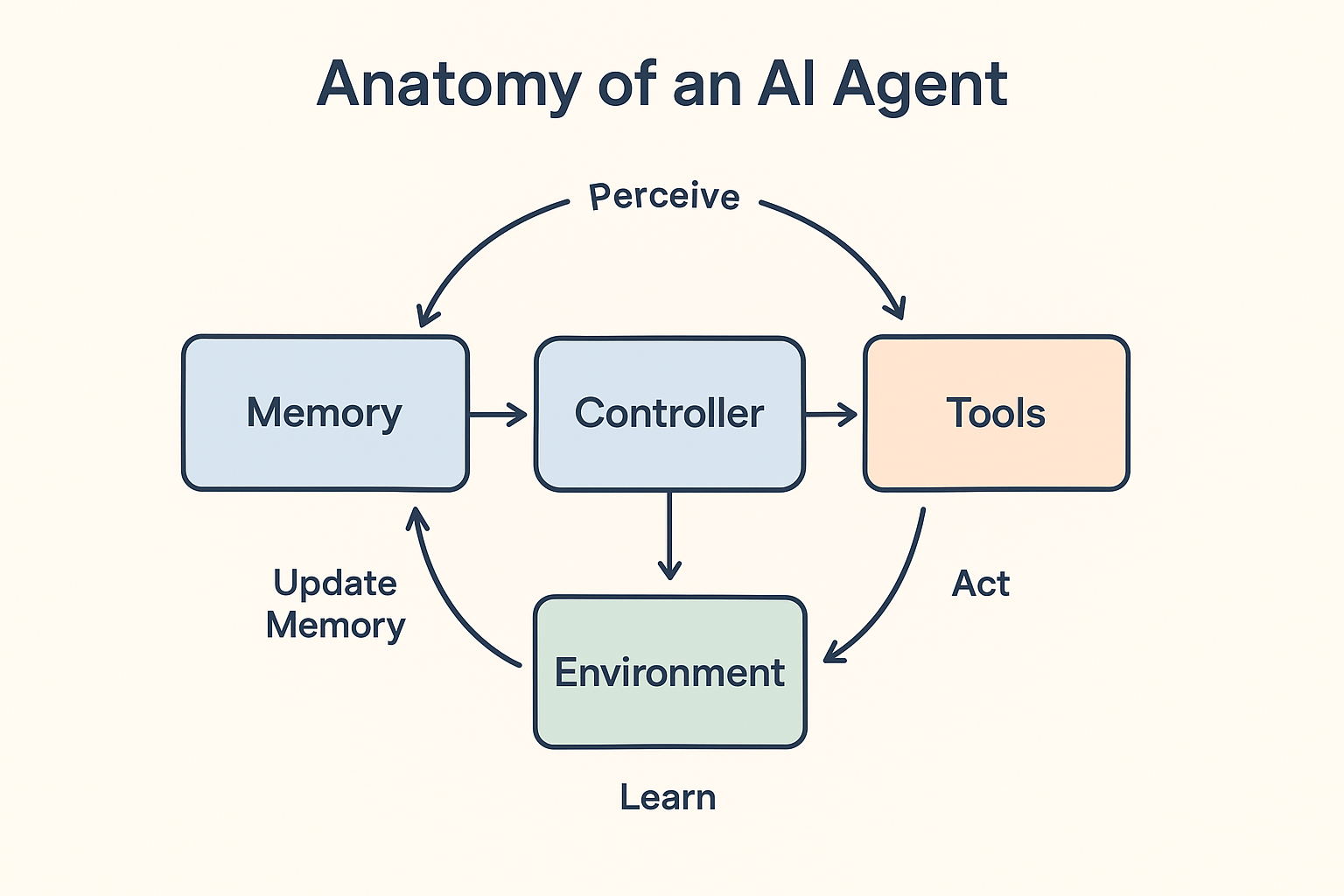
This closed feedback cycle is what makes an AI agent adaptive, context-aware, and capable of improving over time.
Frameworks Enabling AI Agents
Several modern frameworks make it easier for developers to build intelligent, modular agents. Here are three leading ones:
a. LangChain
LangChain simplifies the process of creating LLM-powered agents. It offers:
- Chains for linking prompts and reasoning steps
- Memory modules for context persistence
- Tool integration for external task execution
It’s widely used for building chatbots, knowledge assistants, and autonomous workflows.
b. CrewAI
CrewAI focuses on collaborative multi-agent systems, where each agent has a specific role: researcher, planner, verifier, or communicator. They work together toward shared objectives, mimicking human teamwork.
CrewAI provides mechanisms for communication, coordination, and role assignment, making it ideal for complex, distributed problem-solving.
c. AutoGen
Developed by Microsoft, AutoGen allows multiple AI agents to converse, reason, and refine outputs through dynamic collaboration. It is especially useful for tasks like code generation, scientific research, and project planning, where iterative refinement between agents leads to higher accuracy.
Single-Agent vs Multi-Agent Architectures
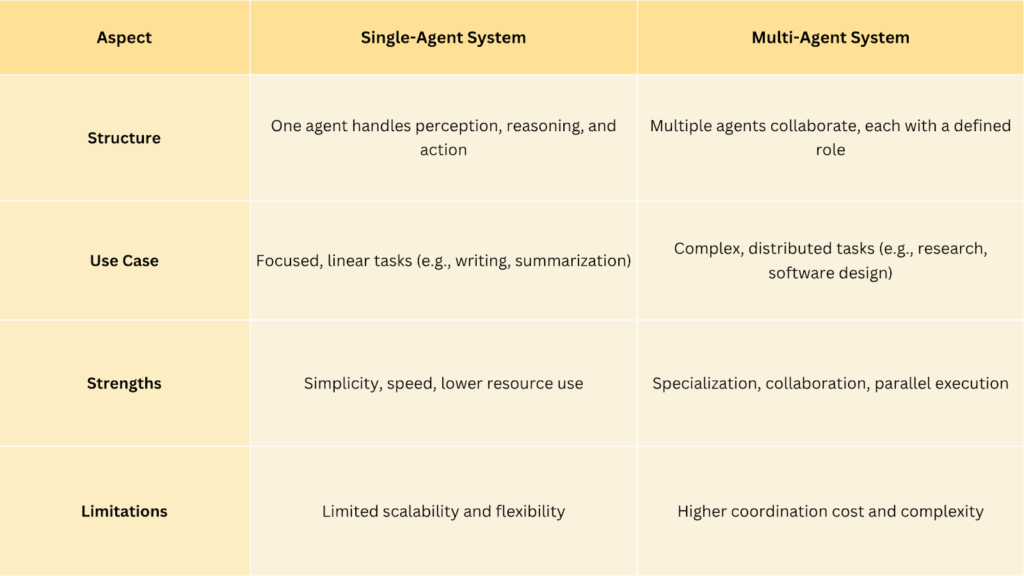
Example: A single-agent setup might power a customer-support bot that handles queries directly. On the other hand, a multi-agent setup could involve one agent retrieving data, another summarizing, and a third validating results, working together for higher accuracy and depth.
Real-World Example
Imagine a research assistant AI agent:
- The controller plans the search strategy.
- Tools connect it to research APIs and summarization models.
- The environment (chat interface) provides user input and displays results.
- The memory stores useful references for later.
If it collaborates with another agent that checks factual accuracy or generates citations, that becomes a multi-agent system which is efficient, distributed, and self-improving.
Challenges in Agent Design
While the architecture is elegant, implementing it effectively presents challenges:
- Memory consistency: Avoiding outdated or incorrect recall.
- Tool misuse: Ensuring the agent invokes the right tool for the right purpose.
- Coordination conflicts: Managing communication among multiple agents.
- Resource efficiency: Balancing autonomy with performance and cost.
- Ethical use: Preventing unsafe actions or unintended consequences.
These are active areas of research, shaping how the next generation of agents will be designed.
Did you Know?
Some AI agents maintain episodic memory, they remember past interactions like experiences and not just data.
Inside every AI agent lies a modular architecture that combines memory, tools, environment, and a controller, all working in a continuous reasoning loop. Frameworks like LangChain, CrewAI, and AutoGen have made it practical to design such systems, while multi-agent architectures point toward the future of AI collaboration.
Agentic AI represents a step beyond reactive intelligence. It’s the foundation for machines that can think, act, and learn, paving the way for a new age of autonomous digital ecosystems.