When we talk about Deep Learning, the heart of it lies in Neural Networks. Just like the human brain processes information using billions of interconnected cells called neurons, artificial intelligence tries to mimic this idea through artificial neurons and neural networks. To truly understand deep learning, it is important to begin with the smallest building block, the artificial neuron.
What is an Artificial Neuron?
An artificial neuron is a mathematical model inspired by the neurons in the human brain. A biological neuron takes input signals from other neurons, processes them, and then either passes the signal along or stays silent. Similarly, an artificial neuron receives input values (numbers), applies weights (importance given to each input), adds a bias (a fine adjustment), and then passes the result through an activation function.
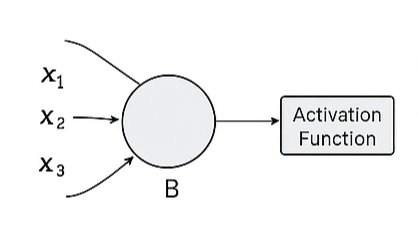
Think of it like this:
- You are deciding whether to go out with friends tonight.
- Inputs: “Do I have homework?”, “Is the weather nice?”, “Do I have enough money?”
- Each input matters differently: homework might matter more than money, so you “weight” it more heavily.
- You add all these inputs up, adjust slightly (bias), and then make a decision (activation).
That is exactly how an artificial neuron works, taking several inputs, processing them, and outputting a decision.
How Do Neurons Pass Information?
Artificial neurons are connected to each other just like in the human brain. The output of one neuron becomes the input of another. This creates a chain of decision-making.
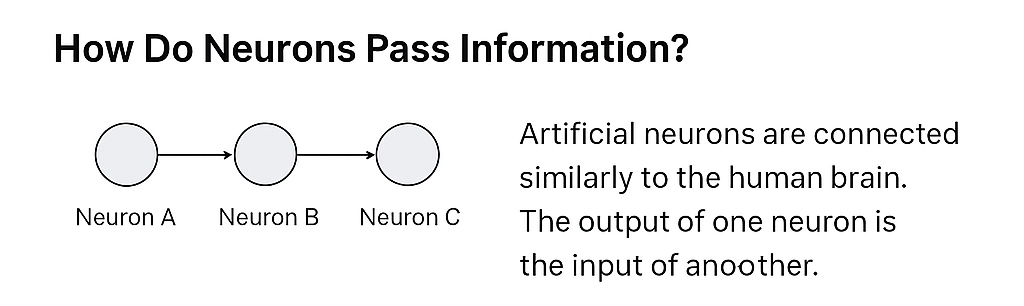
Example:
- Imagine you are looking at a handwritten digit “5”.
- The first neurons might look for small lines or curves.
- The next set of neurons combines those curves into shapes like loops or straight lines.
- Finally, the last neurons decide that the shapes together form the number 5.
This passing of information is what makes Neural Networks powerful, they can break down complex problems into smaller, understandable steps.
AI in News
| A network trained to spot tanks in photos actually learned to identify whether it was sunny or cloudy, because all the training photos of tanks were taken on cloudy days! Read More |
What is a Neural Network Made Of?
A Neural Network is a collection of interconnected neurons arranged in layers. It is like an artificial brain. There are three main types of layers:
- Input Layer: This is where the network first receives data. Each neuron in this layer represents one piece of input information.
- Hidden Layers: These layers are responsible for discovering patterns, features, and relationships.
- Output Layer: This layer gives the final prediction or result.
Diagram: Structure of a Neural Network

How Does a Neural Network Learn Over Time?
Learning in neural networks is about adjusting weights and biases to get better predictions.
- Input Data: Training data (features and labels) is fed into the network.
- Forward Propagation: Data flows from input to output layers of the neural network. As the data passes, each neuron applies weights, bias, and an activation function to it before it reaches the output layer.
- Error or Loss Calculation: The difference between prediction and correct answer is measured.
- Backward Propagation: Error information flows back through the network.
- Weight Update (Optimisation): The network improves step by step by using algorithms to update the weights and biases. This reduces the loss.
This cycle continues multiple times until the model becomes accurate. Each cycle repetition is known as an epoch.
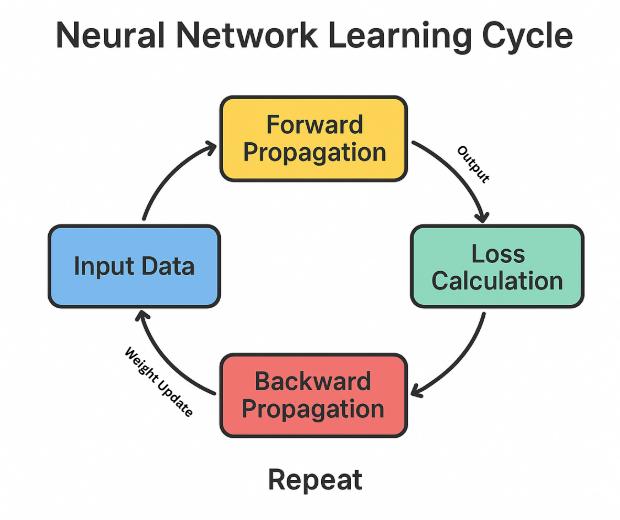
Over time, after many training cycles, the network becomes more accurate, just like humans learn by practising. For example: when we run for the first time as children, we may stumble and fall. Each attempt helps us understand balance, adjust our steps, and improve. Eventually, through repetition and feedback, we learn to run smoothly. Neural networks follow a similar process, learning from mistakes until they perform tasks with high accuracy.
How Neurons and Neural Networks Represent the Human Brain
The inspiration for Neural Networks comes directly from the brain. The brain has billions of neurons that pass signals through synapses. Similarly, artificial networks use millions of artificial neurons connected in layers.
For example, when you recognise your friend in a crowd, your brain first sees small details like colours and shapes, then builds those up into eyes, mouth, and finally the full face. A neural network does something similar when trained on images, it learns from small patterns and combines them into meaningful recognition.
Fun Fact
| Your brain has about 86 billion neurons, each one can form thousands of connections, creating an incredibly complex network. Artificial neural networks are inspired by this, but even the largest AI models today are still tiny compared to the human brain. |
Different Types of Neural Networks
So far, we have looked at the basics of neurons and simple neural networks. But deep learning uses different types of networks for different tasks:
- CNNs (Convolutional Neural Networks): Best for images. CNNs use filters to “look” at small parts of a picture, detect patterns, and recognise objects. These are widely used in face recognition, medical scans, and self-driving cars.
- RNNs ( Recurrent Neural Networks): Best for sequences. RNNs remember past steps, making them powerful for tasks like music generation, speech recognition, and language translation.
Neurons and Neural Networks form the foundation of deep learning. The real strength of Neural Networks lies in their flexibility. Whether it is recognising images, understanding speech, or generating text, these systems can be adapted to many different tasks.