Prompt engineering is entering a new phase. What began as crafting clever text inputs is evolving into designing entire systems of interaction, where humans and AI think, reason, and create together. As models grow more capable and context-aware, the role of the “prompt engineer” is transforming into that of an AI interaction architect, someone who defines how information flows, decisions are made, and creativity unfolds between humans and intelligent systems.
From Prompts to Systems
Earlier, prompts were static, single requests that produced single outputs. But future systems are dynamic and adaptive, using prompts as evolving instructions.
Example:
A legal AI assistant of 2030 might use a network of self-updating prompts that adjust tone, legal precedent scope, and citation depth depending on the user’s expertise level and jurisdiction.

Each stage represents a move from human-crafted commands to self-optimizing AI reasoning structures.
Integration with AI Agents and Autonomous Systems
Prompt engineering will merge with agent-based AI, where models perform tasks independently through reasoning, memory, and external actions.
Example:
A “Research Agent” could autonomously generate hypotheses, fetch new data, test ideas through simulations, and refine its prompts after each iteration. Here, the prompt engineer defines rules, constraints, and feedback mechanisms, not just the input text.
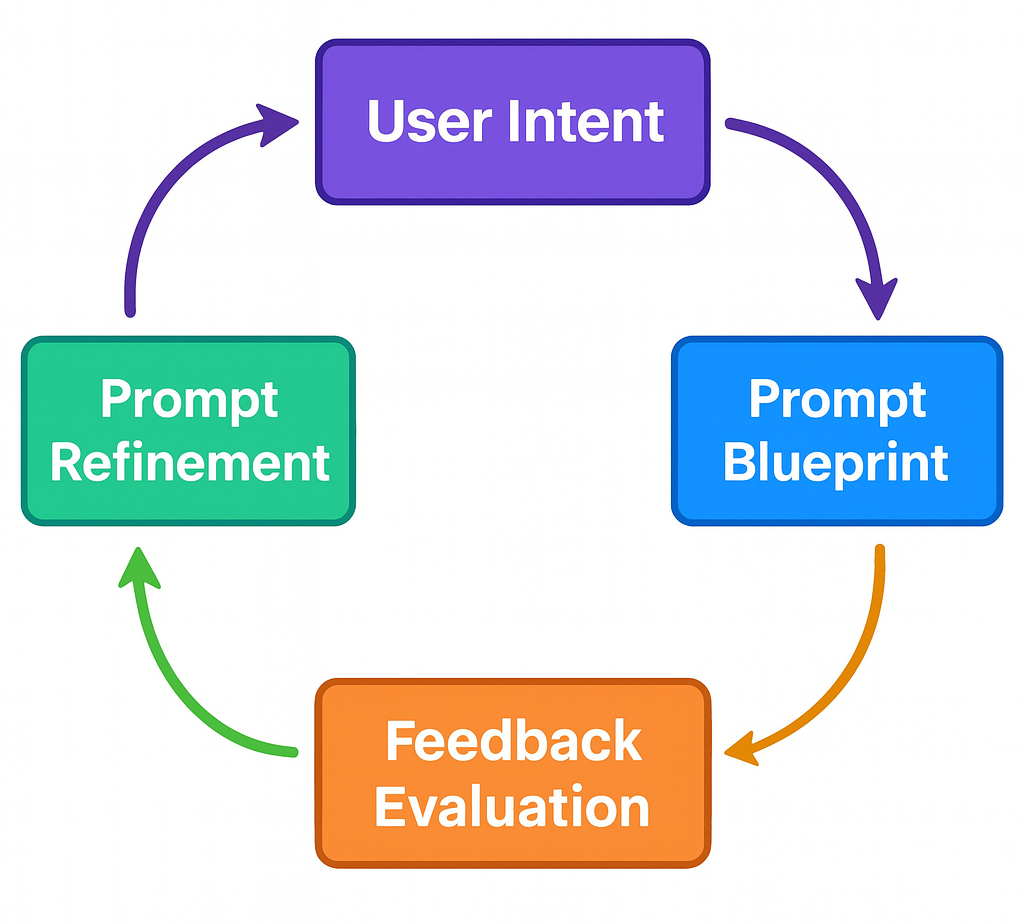
This loop becomes the core of autonomous prompt evolution where AI learns how to prompt itself more effectively over time.
Addressing Current Challenges Through Innovation
Prompt engineering directly addresses many limitations of current AI systems identified earlier such as bias, hallucination, and inconsistency.
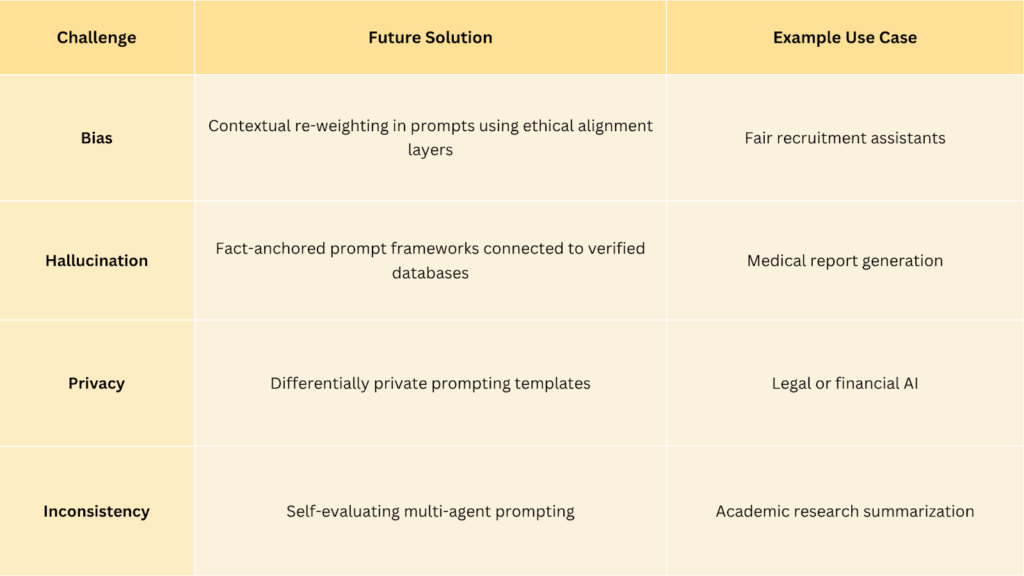
These innovations ensure AI remains reliable, ethical, and transparent, while prompt engineers act as the guardians of trust.
Growth Areas and New Frontiers
- Multimodal Prompting: Future prompts will merge text, visuals, and audio. Designers may craft prompts that teach AI to interpret charts, analyze tone in voices, or design user interfaces.
- Prompt Optimization with AI: Meta-AI models will generate optimized prompts for other AIs. This is a recursive model where machines help us communicate better with themselves.
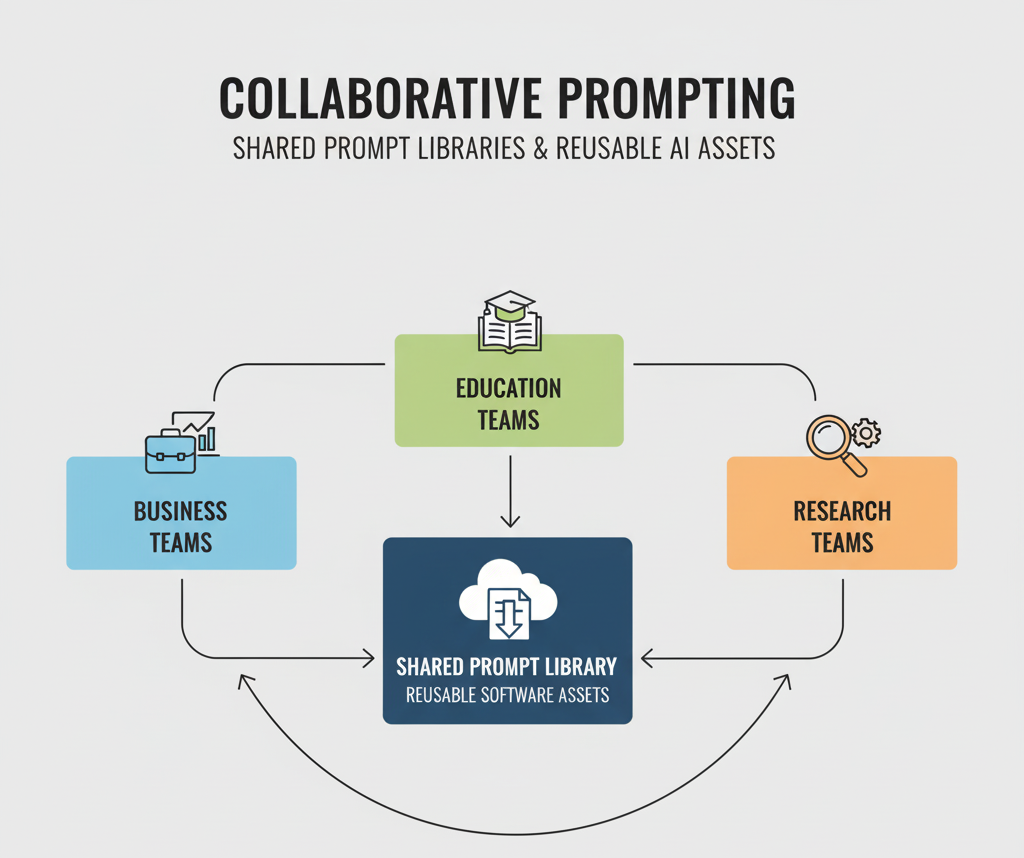
- Collaborative Prompting: Teams across business, education, and research will build shared prompt libraries, treating them like reusable software assets.
- Prompt Governance and Regulation: As AI impacts decision-making, governments may enforce prompt transparency standards such as recording how prompts influenced an AI’s output, ensuring accountability.
Measuring and Scaling Prompt Effectiveness
The future demands a scientific approach to measuring prompt performance.
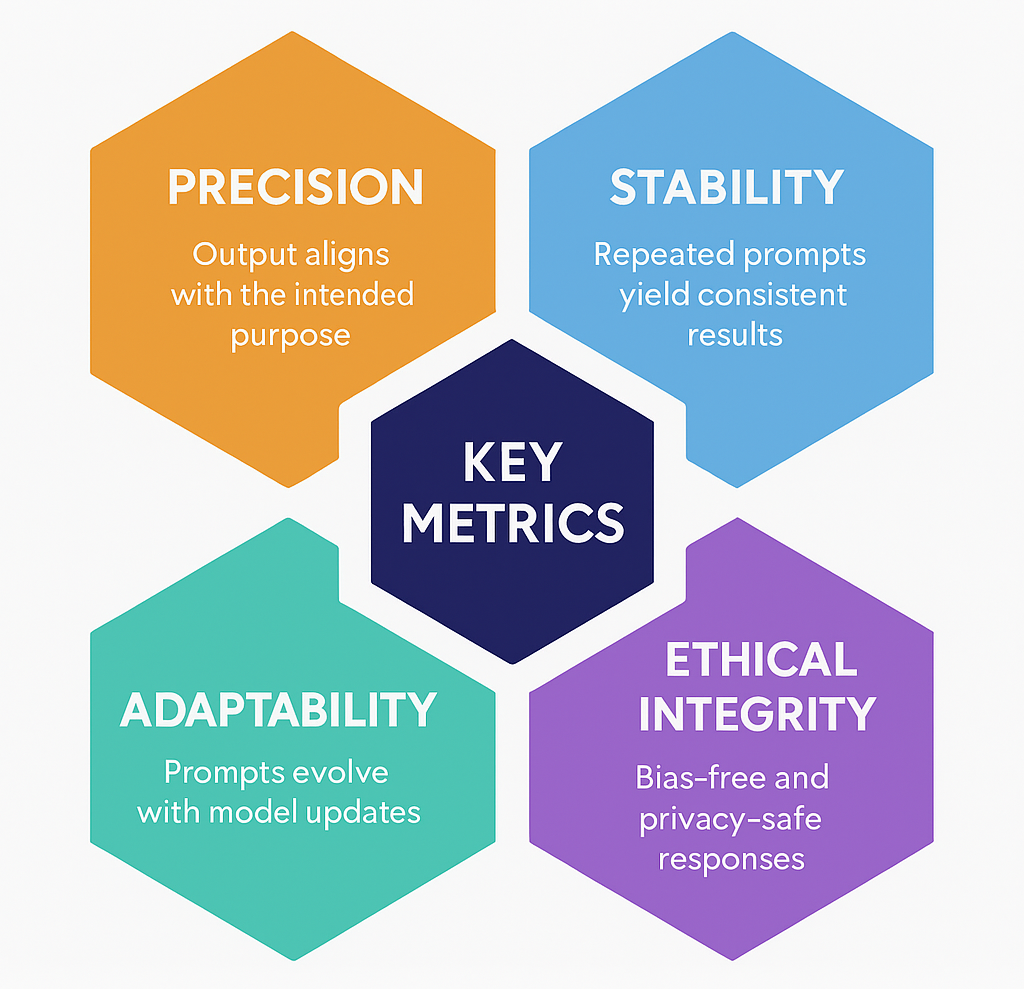
Prompt engineers can use analytics dashboards to track these metrics, refining prompts as living assets, just like software code.
The Expanding Impact of Prompt Engineering
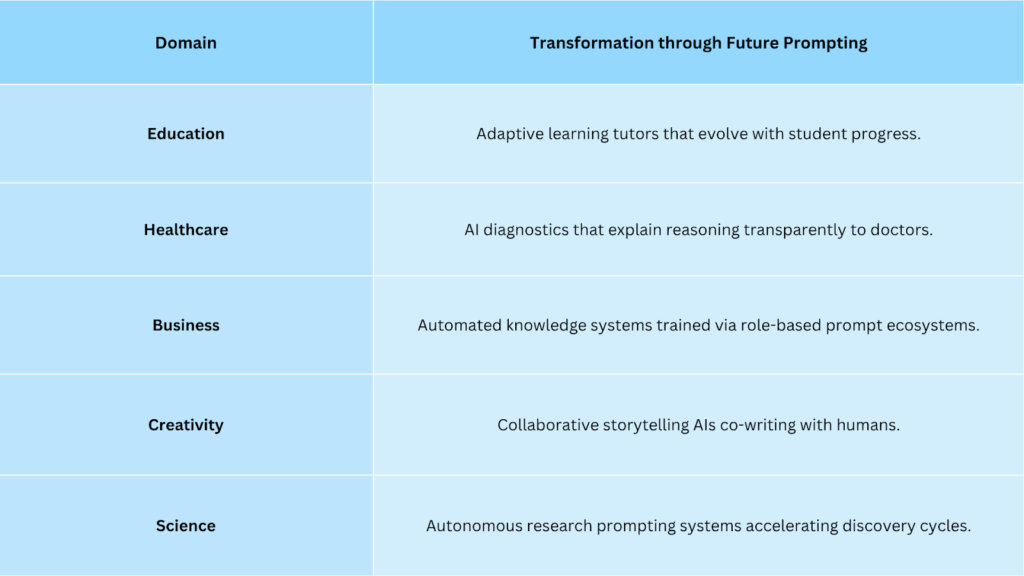
Prompt engineering thus becomes the interface of intelligence, shaping every field that involves thinking, creating, or deciding.
Beyond Prompting: Toward System Design
As models grow more capable, the distinction between “prompt” and “program” will blur.
Future AI design will combine:
- Prompt logic (defining behavior and reasoning),
- System architecture (defining how AIs interact),
- Ethical scaffolding (defining what is allowed and fair).
Prompt engineers will evolve into AI system designers, professionals blending linguistics, psychology, and computational logic to craft intelligence itself.
Prompt engineering is more than a skill, it’s a bridge between human imagination and machine intelligence. Its future lies in adaptability, ethical grounding, and system-level thinking. As AI systems become more autonomous, our words will not just instruct them, they will shape how machines think, reason, and build the world with us.