Generative Artificial Intelligence (GenAI) is a type of AI that can create new different types of content like text, images, music, videos, and more, rather than just analysing existing information. In simple terms, it “generates” content based on patterns it has learned.
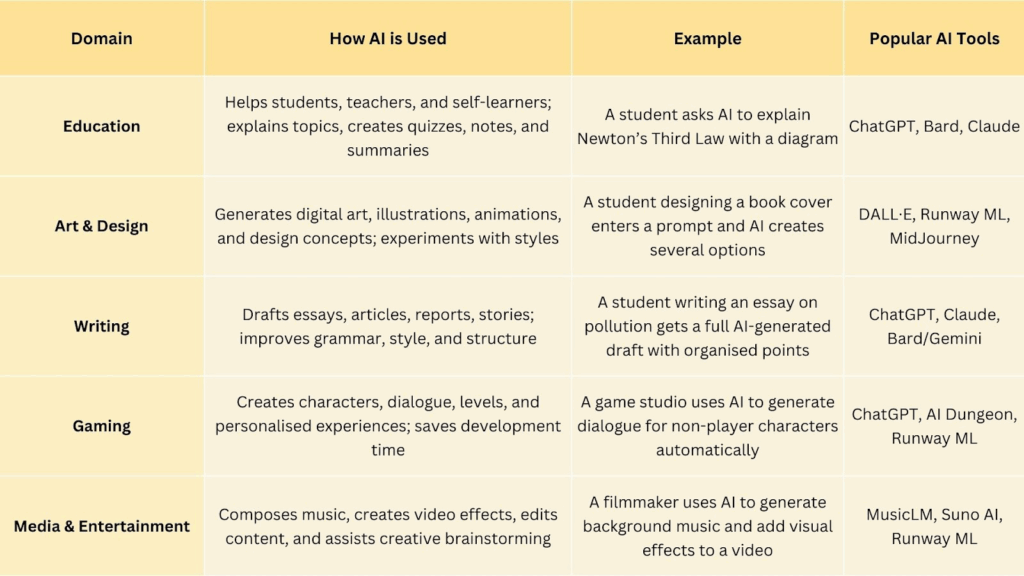
GenAI has grown rapidly in popularity and is being used across a variety of domains, including education, art, writing, gaming, and media. Its widespread adoption shows how powerful it is in transforming tasks that were traditionally manual, creative, or time-consuming. While GenAI is opening new opportunities, it is also leading to job shifts and displacement in some industries, as machines are now capable of performing tasks previously done by humans.
Applications Across Domains
Education
Generative AI is making learning and teaching more interactive, personalised, and efficient. It supports students, teachers, and self-learners alike by adapting to individual learning needs and paces. For example, one student might understand a topic quickly by reading, while another might need pictures, diagrams, or step-by-step explanations to learn it properly. AI makes it possible for everyone to learn in the way that works best for them.

How GenAI is used in education:
- By Teachers:
- Creating customised quizzes, worksheets, and assignments.
- Explaining complex topics in multiple ways for better understanding.
- Generating lesson plans and summaries.
- By Students:
- Asking AI to explain difficult concepts or summarise notes.
- Receiving instant help for homework and practice questions.
- Brainstorming essay ideas or creative projects.
- By Self-Learners:
- Exploring new topics independently with AI-generated guides.
- Practising problem-solving with AI simulations.
- Enhancing skills in coding, languages, or creative arts using AI tutorials.
Fun Fact
ChatGPT has a Study Mode, designed to help students revise topics, create flashcards, and even quiz themselves interactively.
Example: A student struggling with understanding Newton’s Laws types: “Explain Newton’s Third Law with real-life examples.” The AI generates a clear, step-by-step explanation and even gives a diagram of a rocket launch showing action and reaction forces.
Art & Design
Generative AI is changing how people make art and design. It lets artists, designers, and even beginners try out new ideas, styles, and layouts quickly. Work that once took hours or days can now be created in just minutes with AI tools.
This technology also makes it easier to experiment by giving many different versions of the same idea. Creators can then choose, adjust, or combine results to improve their work and explore new directions. Even people who don’t have strong drawing skills can make high-quality art, opening up endless creative possibilities.
How GenAI is used in art and design:
- Artists:
- Generate concept art for books, movies, or games.
- Experiment with new styles, colours, and compositions without starting from scratch.
- Designers:
- Create illustrations, logos, or advertisements quickly.
- Test multiple design variations for clients efficiently.
- Hobbyists & Learners:
- Explore personal creativity using AI tools to produce unique artwork.
- Learn design principles interactively through AI suggestions.
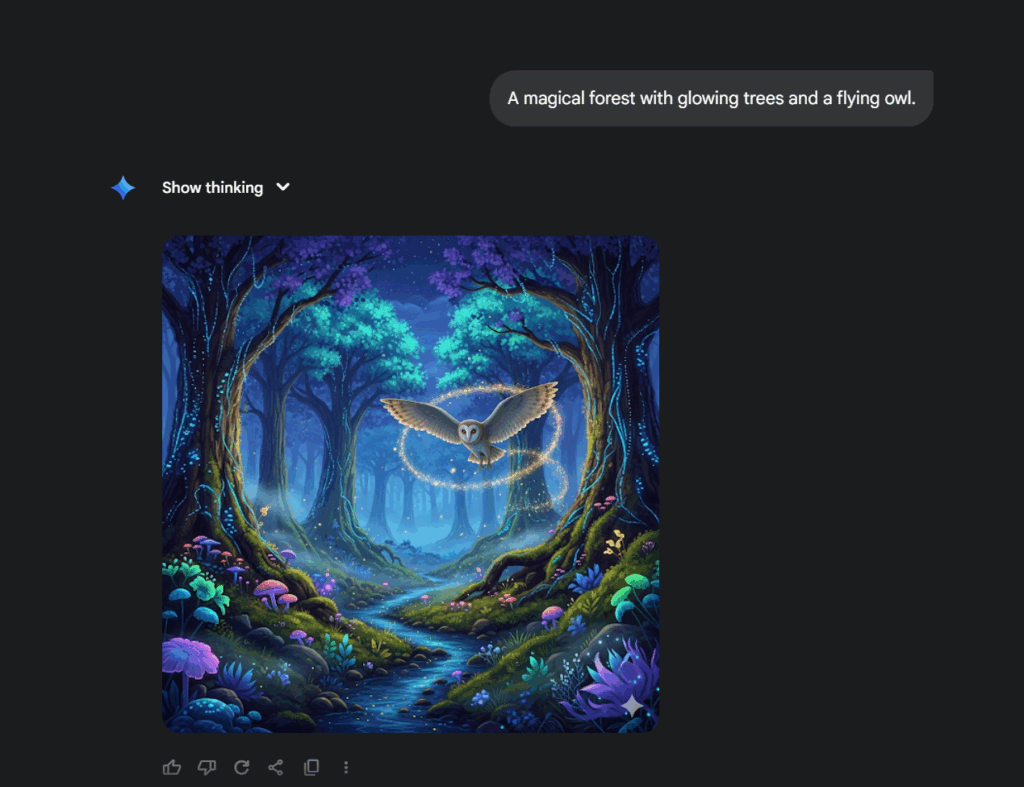
Example: A student wants to design a book cover but has limited drawing skills. They enter a prompt in Gemini: “A magical forest with glowing trees and a flying owl.” The AI generates several options, which the student can tweak and use for their project.
Fun Fact
AI-generated art recently sold for $432,500 at a major auction, proving its rising influence in the art world.
Writing
From school essays to professional reports, generative AI is transforming the way people approach written work. Instead of starting with a blank page, writers can use AI to draft, edit, and organise their ideas more efficiently. These tools don’t just generate text, they also suggest improvements in grammar, tone, and style, helping people communicate more clearly.
For students, this means having a study companion that can explain difficult topics in simpler terms, summarise large amounts of information, or offer fresh ideas when they feel stuck on an assignment. For professionals and content creators, AI speeds up the writing process by creating first drafts, offering alternative phrasings, and even brainstorming creative directions that might not have been considered otherwise.
By blending speed with creativity, generative AI reduces the time and effort needed for writing while boosting quality. It gives people more room to focus on their ideas, making it possible to write faster, refine more easily, and feel more confident in their final work.
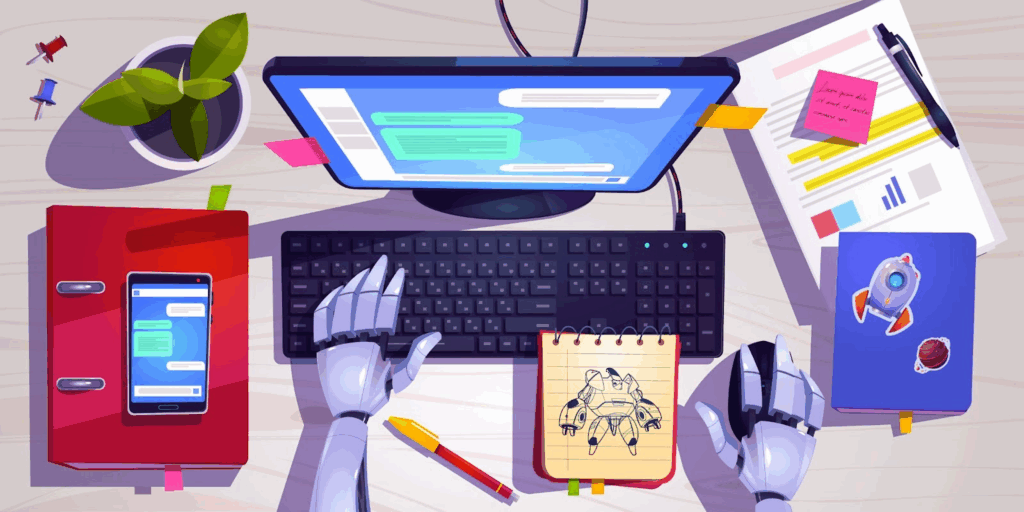
Example: A student writing an essay on climate change types: “Explain the effects of air pollution.” The AI generates an organised essay with points on health, environment, and industries contributing to pollution.
Gaming
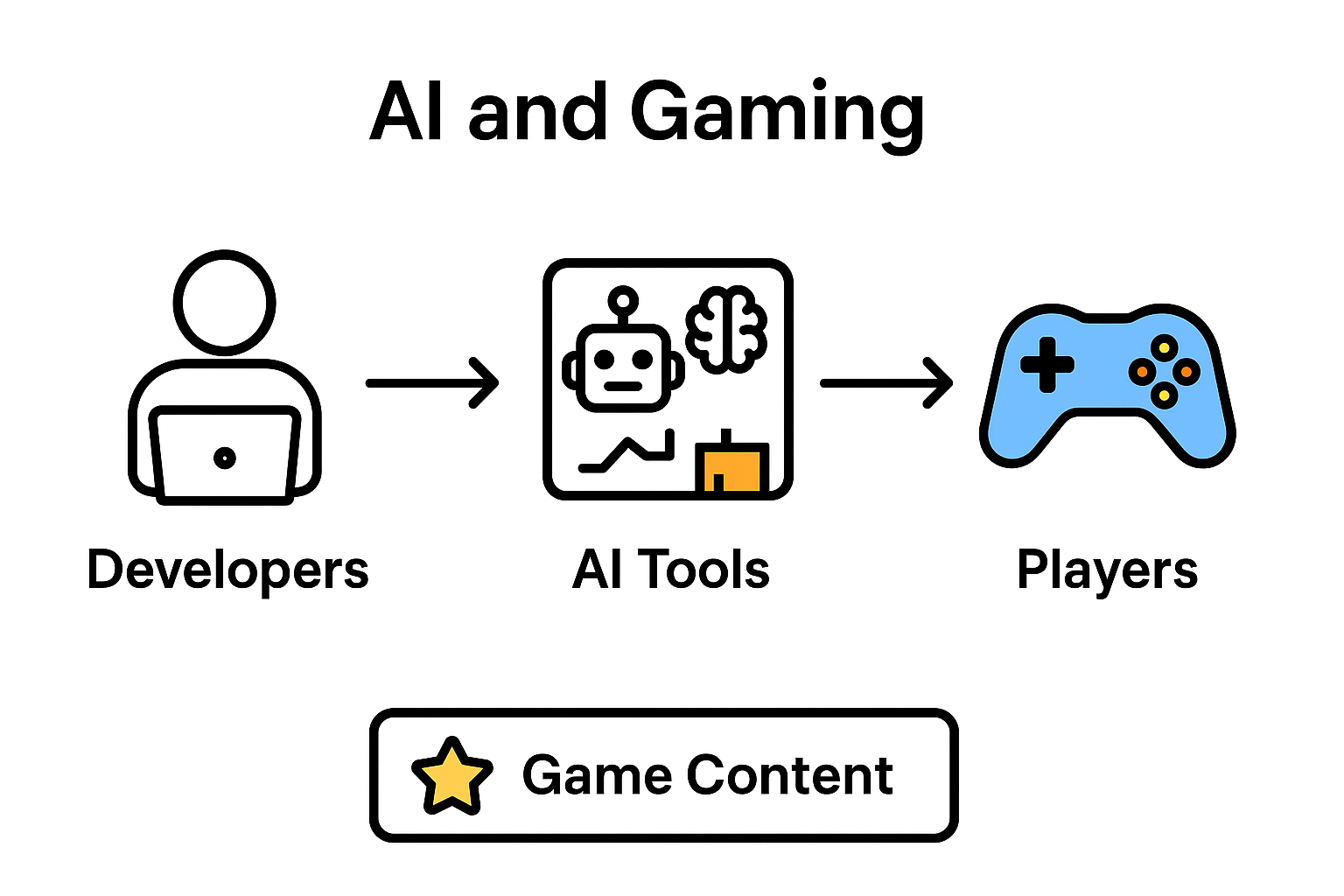
AI is changing the gaming world in big ways, making both development and gameplay more exciting. Game developers can use AI to design realistic characters, natural-sounding dialogue, and even full game levels much faster than before. This frees up time for developers to focus on the creative side like building better stories and gameplay, while AI takes care of repetitive or time-consuming work.
For players, AI makes games feel more personal and dynamic. Challenges, quests, and storylines can adapt to each individual’s style, making every playthrough unique. It also creates richer, more immersive worlds that respond and evolve over time, keeping the experience fresh and engaging.
In the future, AI could allow games to generate endless new content, meaning players might never run out of things to explore. This mix of creativity and adaptability is setting the stage for a new era of interactive entertainment.
Example: A game developer uses GenAI to generate dialogue for hundreds of non-player characters in an adventure game, making the world feel alive without manually writing every line.
Fun Fact
Some gaming companies now use AI to generate entire virtual worlds in hours instead of months.
Media & Entertainment
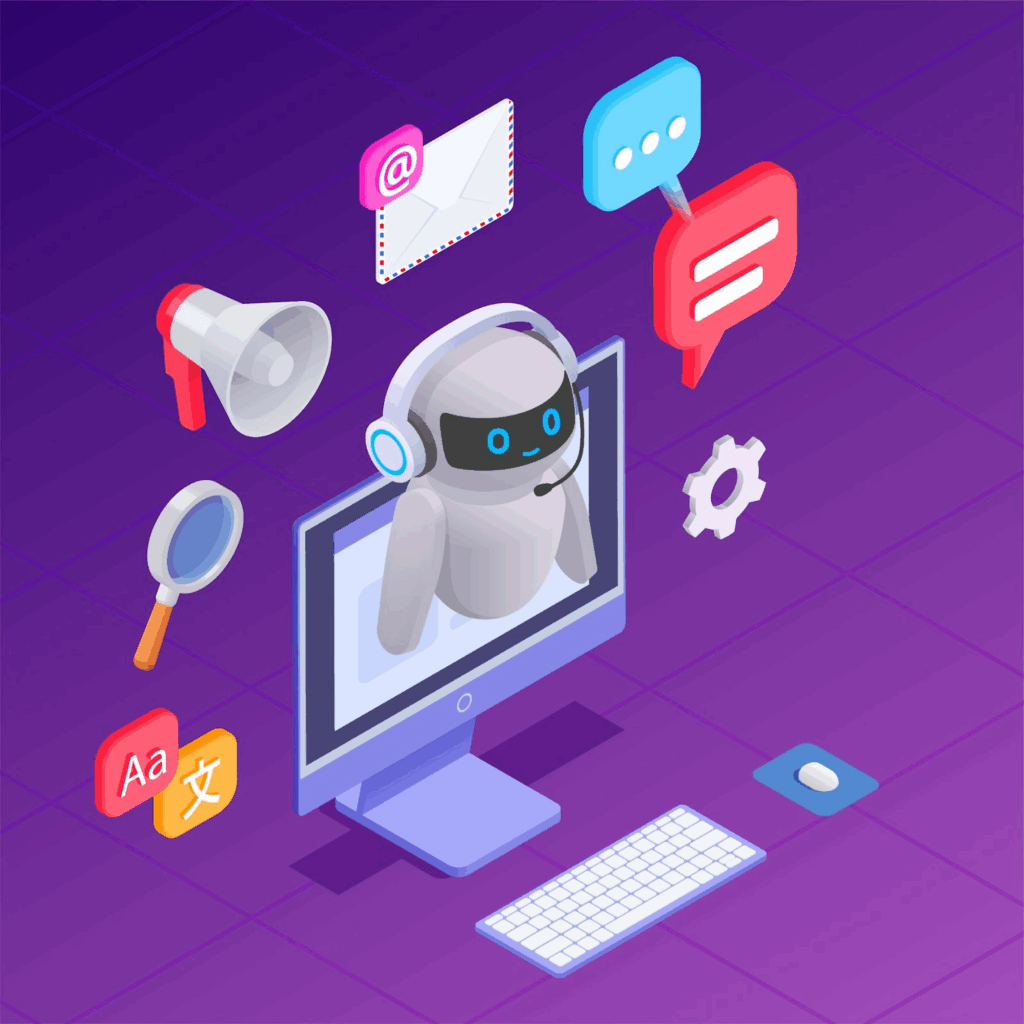
Generative AI is reshaping the world of music, film, and digital media by making the creative process faster, easier, and more accessible. Musicians can use AI to compose original songs, mix tracks, or even generate entire melodies in specific styles. Filmmakers and video editors are able to add realistic visual effects, edit footage, or design animated scenes without spending weeks on production. For content creators, AI tools can speed up video production, suggest fresh concepts, and handle repetitive editing tasks.
Beyond saving time, AI also encourages experimentation. Artists and creators can quickly try out multiple versions of a project, whether it’s a different beat in a song, an alternate cut of a video, or a new cinematic style. This flexibility leads to more creative freedom and opens doors to ideas that might not have been possible with traditional methods.
For audiences, the result is more diverse and engaging entertainment. From personalised playlists to interactive films and AI-generated performances, the boundaries of what counts as “entertainment” are constantly expanding. By blending creativity with technology, generative AI is creating a future where anyone can be part of producing music, videos, or movies, regardless of their technical skills.
AI in News
According to recent reports, companies are increasingly integrating GenAI for innovation, and the global generative AI market is expected to grow at over 30% annually, proving its rising impact on the world.
Generative AI is a transformative technology, reshaping how people learn, create, and work. From classrooms to creative studios, it provides tools to generate text, images, music, and more, making tasks easier and faster. While its rapid adoption is creating new opportunities, it also highlights the need to adapt to a changing job landscape. By understanding and using GenAI effectively, students and professionals can enhance creativity, productivity, and problem-solving skills while preparing for a future where AI plays a central role in almost every field.